Pierre-Henry Gomont's Soviet Land In Four Pages
It’s a moment of recognizing that the past is the past and it is time to move forward.

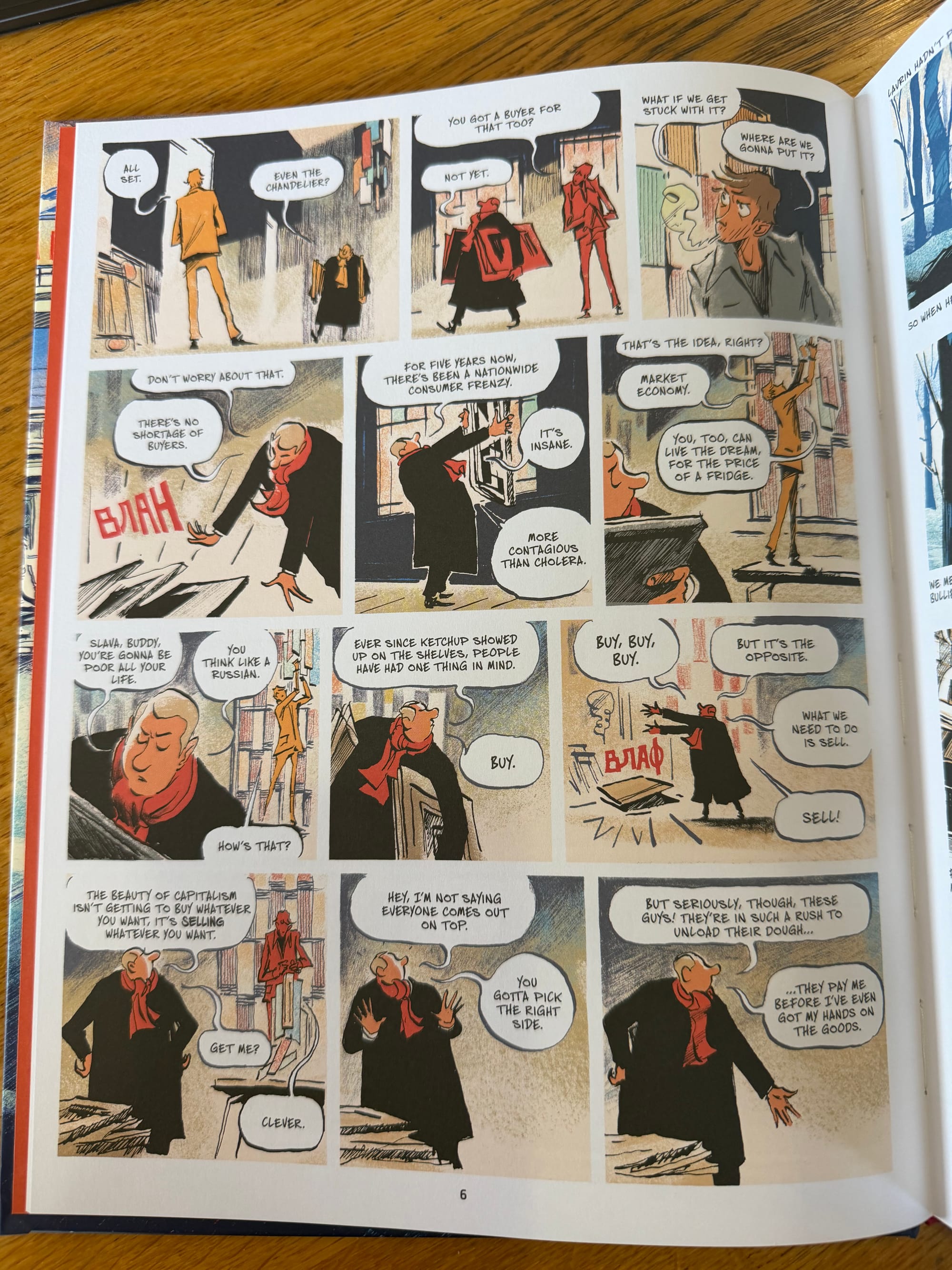
“The beauty of capitalism isn’t getting to buy whatever you want. It’s selling whatever you want.” (Page 6)
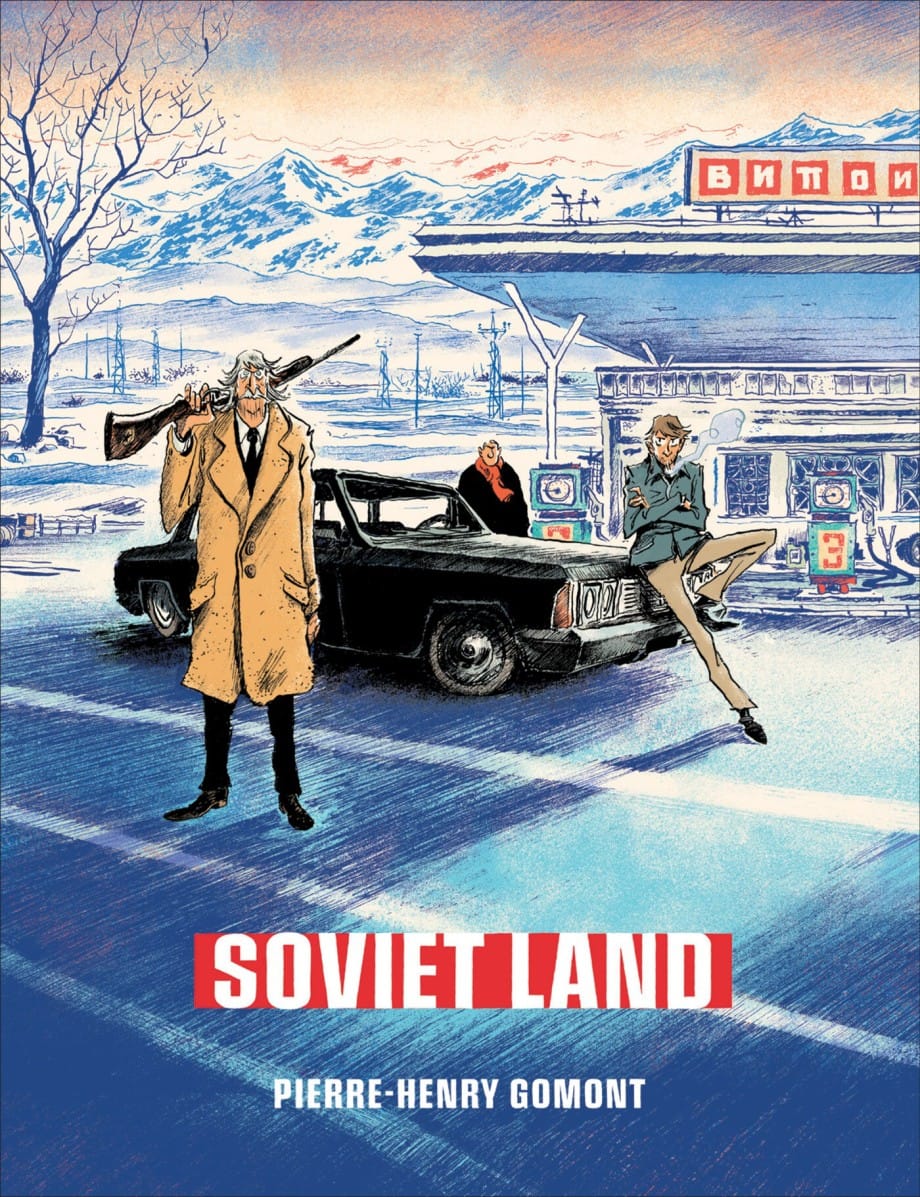
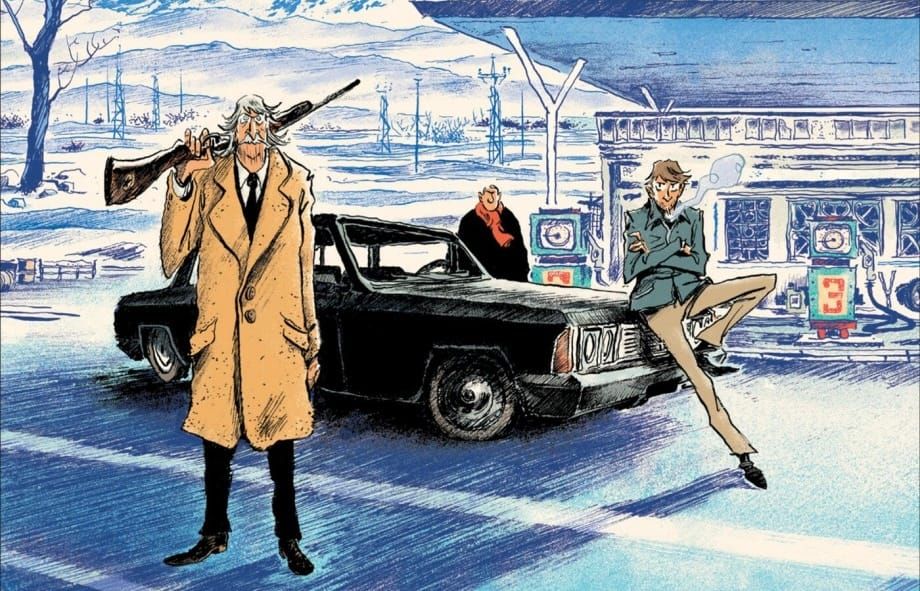
Pierre-Henry Gomont’s Soviet Land (originally published in France by Dargaud as Slava Books 1-3) explores what it means to sell something, whether it’s Soviet-era knick-knacks, mining equipment, art, or your own integrity. The Russia that Gomont shows here is still trying to figure out what it will be after the collapse of the Soviet Union. It’s practically wide open for a opportunistic capitalists looking to profit off the power vacuum left by the fall of the political system. Without an oppressive hand over its people this Russia is wide open and ready to be exploited.
This early page sets up the main dilemma of the book, and a particular nugget of wisdom comes from Lavrin, a small time operator just looking for an opportunity to make something of himself and maybe the most complex but self-aware character in the book. “You gotta pick the right side,” he tells Slava, his boyhood friend You are either a buyer or a seller in this new Russia. That’s seeing the world a bit too black-and-white but Lavrin sees only two sides to this— buy or sell. For Lavrin, the right side— the winning side—is unbridled capitalism, something that most Russians have only recently gotten a taste of but has existed all along for those powerful enough to know how to play the previous system. But it’s got to be a bit more nuanced than that, right? Maybe the truth he’s talking about here isn’t buying or selling but about the choice you make of which side you’re going to participate in or if you are going to accept these two choices as the only ones. Lavrin has already made his choice even before the book begins and that choice guides every subsequent decision he makes.
As Lavrin and his friend Slava scavenge through an old Soviet-era building looking for anything they can make a buck off of, Slava is completely out of his element. In his narration on the first page, Slava tells us “I’ve got no head for business,” so we can read page 6 as the beginning of his education by his friend and mentor Lavrin. Once an artist, this new Russia seemingly has no need of art. Slava is trying to figure out his place in this new world. Gomont is fascinated by these displaced people, not geographically but societally displaced as all the rules they knew growing up no longer exist. Slava and Lavrin stand on the edge of a new Wild West; the beliefs and systems that they grew up in and thought were forever have proved to be temporary and have disappeared.
So here they are in this new world where morals and ethics are practically still formless as their country tries to figure out what it wants to be. The world around them is lost and directionless as these two men feel abandoned by a system that Slava artistically rebelled against while Lavrin sees nothing but opportunity and fortune ahead of him.
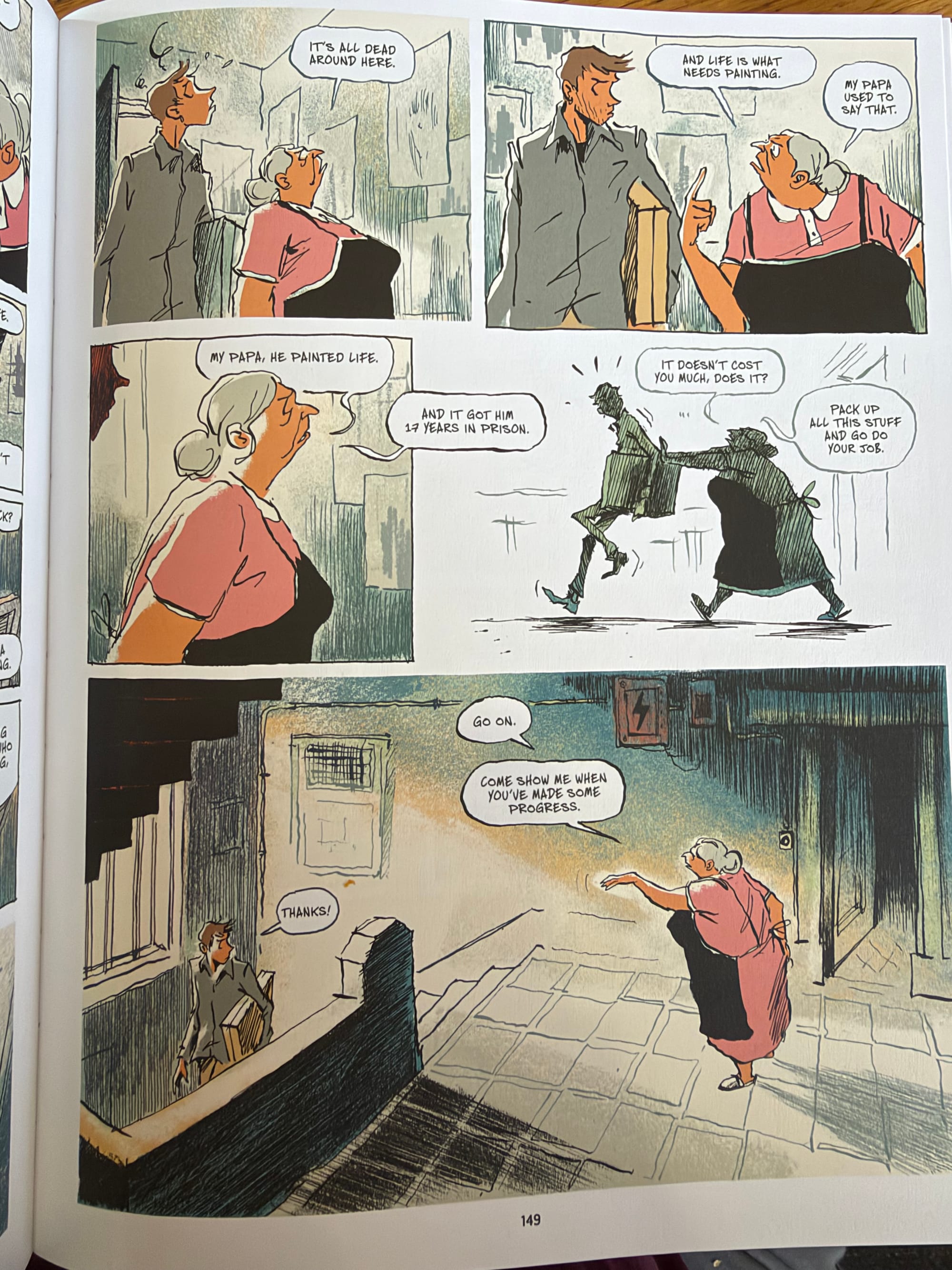
“And life is what needs painting.” (Page 149)
Following that initial scavenge job and getting lost in the surrounding woods, Slava and Lavrin meet Nina, a young woman from a nearby mining town that’s struggling to survive. A Russian businessman wants to buy all of their equipment- so they would have the mine but not the equipment to do the work. The relationship between Lavrin, Slava, Nina, and her father Volodya starts as one of need— Volodya and Nina are trying to hold on to their way of life which requires money. Lavrin, being the opportunistic capitalist he is, sees their need as the perfect opening for him to practice his art. And Slava is pulled along for the ride, trying to be supportive of his longtime friend while falling in love with a woman he just met.
For most of the book, Slava tries to exist in Lavrin and Nina’ worlds— the world of a seller and the world of a survivor. But neither world is where he comes from or belongs. Slava gained some notoriety during the last days of the Soviet empire by painting people oppressed by the system. Since the collapse of the empire, he’s felt like he hasn’t been able to do anything meaningful. You can tell that he has lost his passion for work and life and is searching for something to give his life meaning. That’s why he fell in with his old boyhood pal Lavrin in looting and selling off parts of the old Soviet culture.
Eventually as Slava and Nina begin to fall in love, she wants to see his art so Nina sends Slava to an old woman in town to get art supplies. He’s given up the dream of art but for Nina, he’ll try it again. Slava is told that the art supplies are the old woman’s father’s— his possessions that she’s kept in his memory. He was jailed for his art— that’s how important and dangerous art can be. Slava once felt this way and that is what he has lost— that passion to be dangerous. Gomont makes an interesting call here— he never shows us anyone’s art; the characters just talk about it. He leaves these images up to the reader’s imagination. But the old woman sends Slava off with her father’s words, “And life is what needs painting.” While he thinks he’s no longer an artist, she admonishes him to connect with the life around him more than he is. For much of the book, including after this scene, Slava follows other people, letting them take the lead. It is as if he is cared to be his own person; he’s trying to be what everyone else thinks he should be.
Similarly to Slava, Lavrin finds his own older woman to be his patron and mentor at this time. Magdalena Ivanovna Grishenka is part of the world that Lavrin wants to be in. She is Lavrin’s sugar momma but it’s more than that. He had been looking for a mentor, and a legitimate entry-point into the higher world of selling and buying. Magdalena, he believes, gives him a legitimacy that he longs for. So there are these two older women, one rich and traveling in the right circles and the other just another old woman living well within her lesser means, who in their different ways take these young men under their wings to teach the ways of their worlds. Each woman provides the path and the future that these young men are looking for.
The time spend with these women is so different— Slava’s times with the old woman are these brief encounters but are so pivotal to his growth, whereas Lavrin gets what he wants and much more out of it. Magdalena uses Lavrin as much as he uses her. Slava gets a calling; “Pack up all this stuff and go do your job.” That’s an affirmation that Slava has been looking for. It’s a simple, almost flippant line but it’s a strong counter to Lavrin’s worldview that the selling and buying of stuff is our highest calling.
“Don’t be like us.” (Page 195)
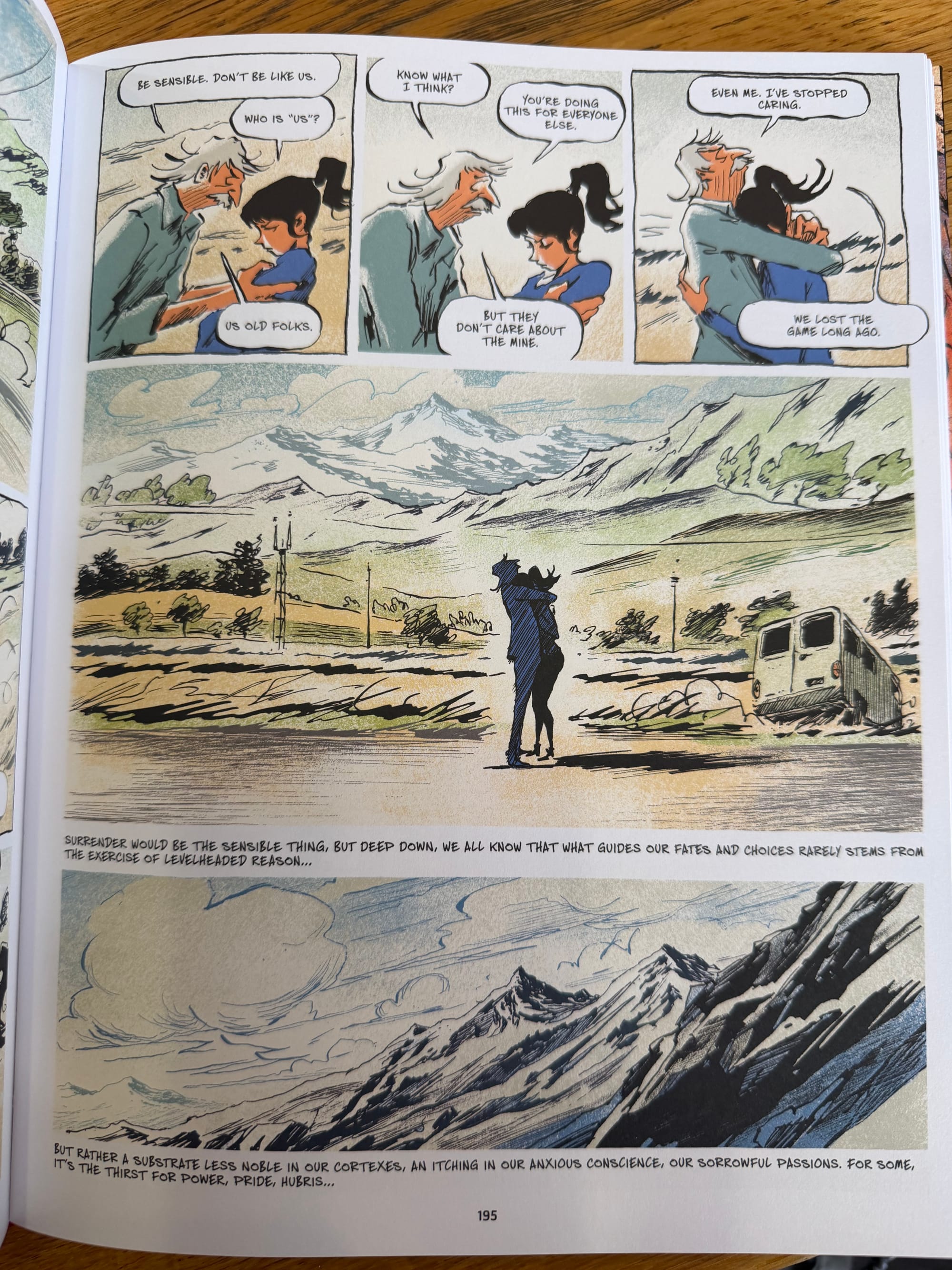
This is the breaking point in Gomont’s book— the moment where you realize that Slava, Nina, Yolodya, and even Lavrin have been working for the past and have lost sight of the future. It’s a moment between a father and a daughter that’s so small and personal but Gomont in the two large panels tells us that we all are part of it as well. It’s a moment of recognizing that the past is the past and it is time to move forward. But we also recognize in this moment that the future is not for everyone. Yolodya is a fascinating character. He’s a bear in this story, often in his own world. Maybe this is what a Russian father is like but he’s nothing like what you or I think a father is. As a person, he’s largely unreadable except for his contempt for Lavrin but he’s willing to use him if it means saving his way of life. This hug on the side of the road is the most vulnerable and fatherly he gets in Soviet Land.
He’s the old man of the story. Nina wants to be her father’s daughter, Slava wants to be an artist, Lavrin wants to be a capitalist but at this stage in his life, and Volodya just wants the life he had under communism. It’s what he knows but he also knows it is not the life for his daughter’s future. In trying to save the mine, all four of them have found some kind of meaning but it all feels fleeting. Russia is in the middle of a transitional time and its people are caught up in the country's growing pains.
Volodya is at the point in the story where he is realizing that they can’t win. And maybe he’s just too tired to see this through. He’s not going to get what he wants. It’s a rare moment of tenderness for him, hugging his daughter and wanting something else for her that’s different from what he thought he wanted for both of them. As he was fighting, he was fighting for her and her future. Up to this point in the story, he’s been this impenetrable being— silent, brooding, and violent.
Volodya holding his daughter tightly here is an inversion of what their relationship up until this point has been. He’s not very fatherly; she often just refers to him by his first name. When we first see Volodya standing out in the Russian snow in just his underwear, the only way that you know their family is that she tells Lavrin, “he’s my dad.” But as you get deeper into the book, you can see that he means everything to her. Her actions are for him, what she does for the mine is for him. Slava is a distraction from that but she’s invested in the mine and the miners because Volodya is. It’s not like Gomont ever has her say it but you know she wants her father to be proud of her.
And that’s what this page is— his pride in and his love for his daughter. She still has the drive to see all of this through in ways that he no longer recognizes in himself. He knows that there is no way for them to win here. So Gomont gives us one moment of him being a father and Nina being a daughter. It’s one of the most heartfelt pages of the book and shows that with everything happening to them, there’s still room for human connection in this changing world.
“This wasn’t a game you ever really thought you could win, was it?” (Page 272)
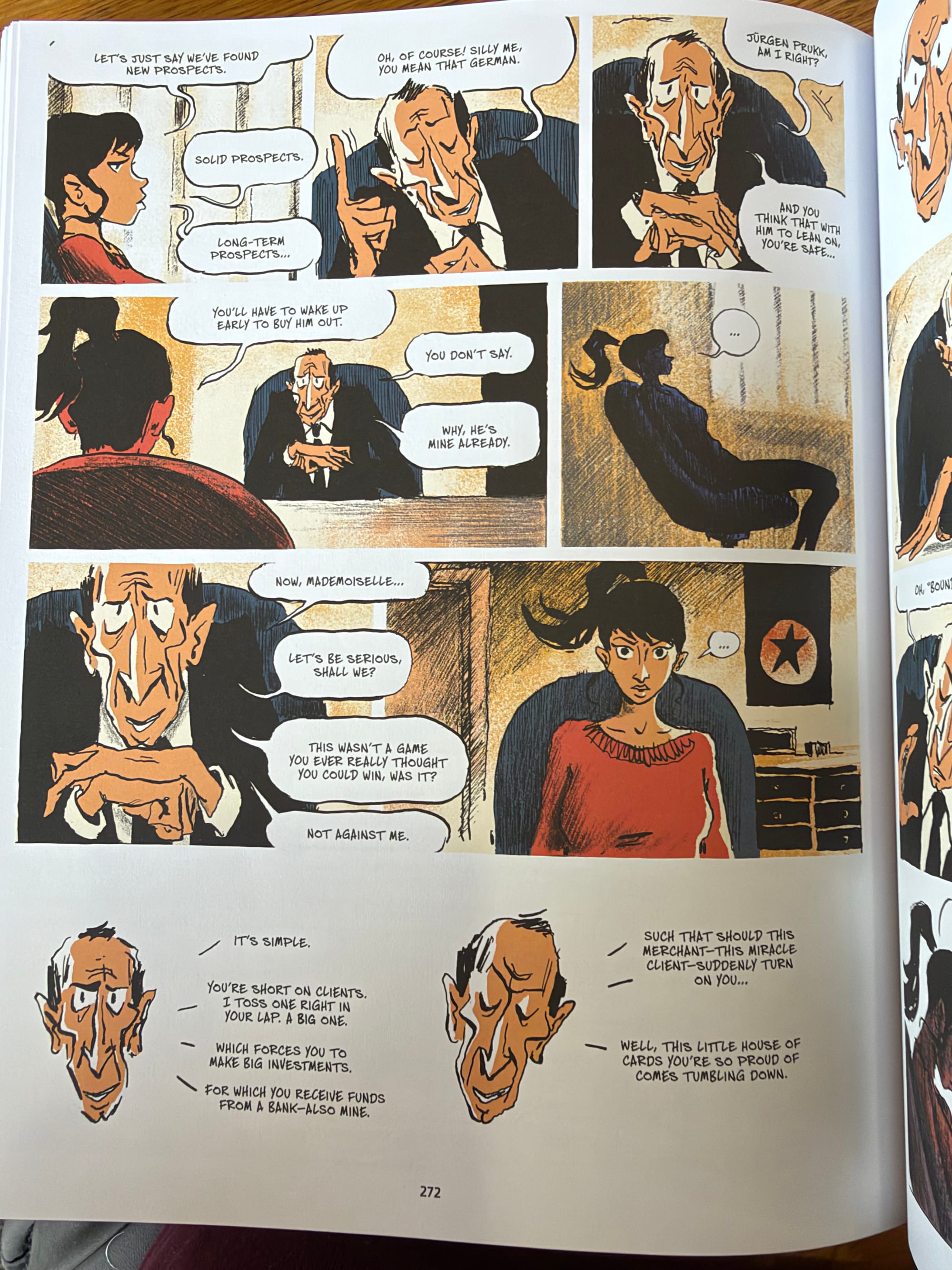
Morkhov is the businessman who originally had a deal to buy the mine’s equipment until Lavrin, Slava, and Nina came up with a plan to screw him over and keep more of the equipment for the miners. For him, losing the equipment was chump change but he took it very personally that anyone thought they could pull one over on him. It’s the cruelest page in the whole book as Morkhov explains how this world actually works to Nina. This is what Volodya was triaging to spare Nina from. While Nina and company thought they could actually pull all of this off, Morkhov was just pulling their strings, leading them on and waiting for the moment to pull everything down around them.
It’s not so much the surprise of this page but the gleeful ruthlessness that Morkhov takes in explaining his tactics to Nina that sets up the book's conclusion. As we’ve followed Slava, Lavrin, Nina, and Volodya’s attempts to take some control of their world, this page shows us just how little control most people will ever have. This story is very much a story of the one percenters and everyone else, just framed around the fall of the Soviet empire instead of the heady days of more recent financial collapses. Gomont explains how the world works here and how it is set up to screw over most of us. So the sotry becomes not about saving the mine but how do we recognize unfair systems and start working to change them to create a better world.
Nina starts this meeting feeling like she’s in control but by the fourth panel, a great silhouette image of her realizing that her world is crumbling around her, she knows it’s men like Morkhov who really control this world. Not Slava. Not Lavrin. And not her father. They’re just dollars and cents for Morkhov to move around and play with. So much of this book has been about these four people trying to understand this brave new capitalistic world so that they could have a piece of it and then finding out that was just a dream.
While this is happening to Nina, Slava is off trying to sell some of his art he’s been creating with the old woman’s supplies. As Gomont shows it, the art world is a strange blending of art and commerce. Slava is trying to produce capital “A” Art but the market is just looking for wall decorations that will match the furniture in their room. Slava is having a similar realization to how the world works as Ninais but the intentional cruelty of Morkhov’s actions is more shattering.
Even though Soviet Land is a period piece, Pierre-Henry Gomont prods us to question what do we want the world to be. That starts with having to see the world for what it is and to have an idea of what it could be. Through these four main characters that have such different hopes and dreams, we see that their primary adversary isn’t another person not another person but the systems that are set up to benefit only the system and those who control the system. By setting the story in the former Soviet Union, he gives his story enough room to be just a story of these four people. But he also gives his audience the room to question is this a story about Russia or is there something more contemporary here, something that speaks to our human condition in the 2020s.
Thank you for reading From Cover to Cover.
Click here to receive new posts in your email and support our work through a tip at Ko-Fi.