Buckle Up for Deniz Camp and Javier Rodríguez's Absolute Martian Manhunter
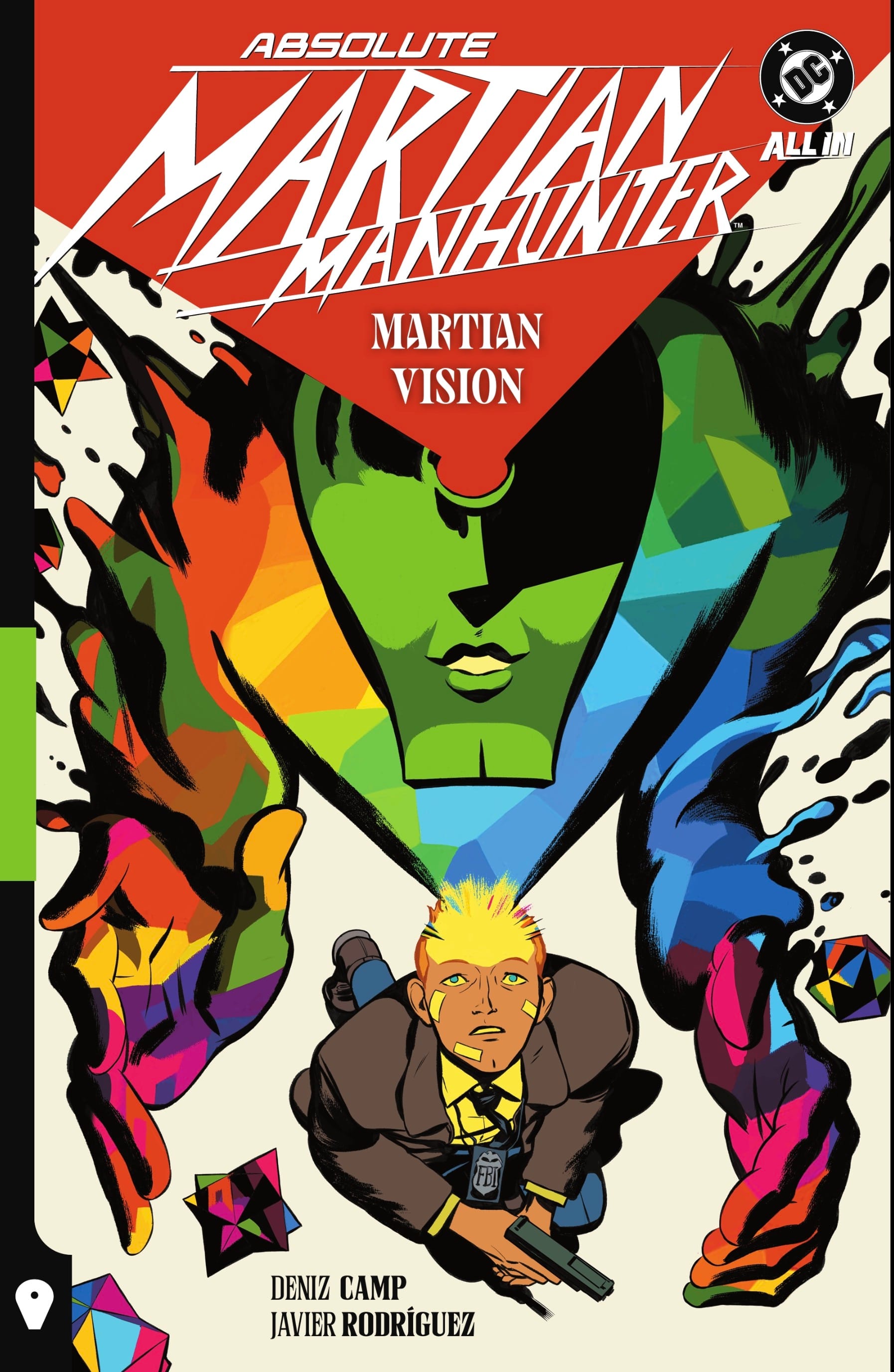
The infection of Martianvision makes Absolute Martian Manhunter an interactive read because you need to engage with the art to really understand the breakdown that FBI Agent John Jones is going through.

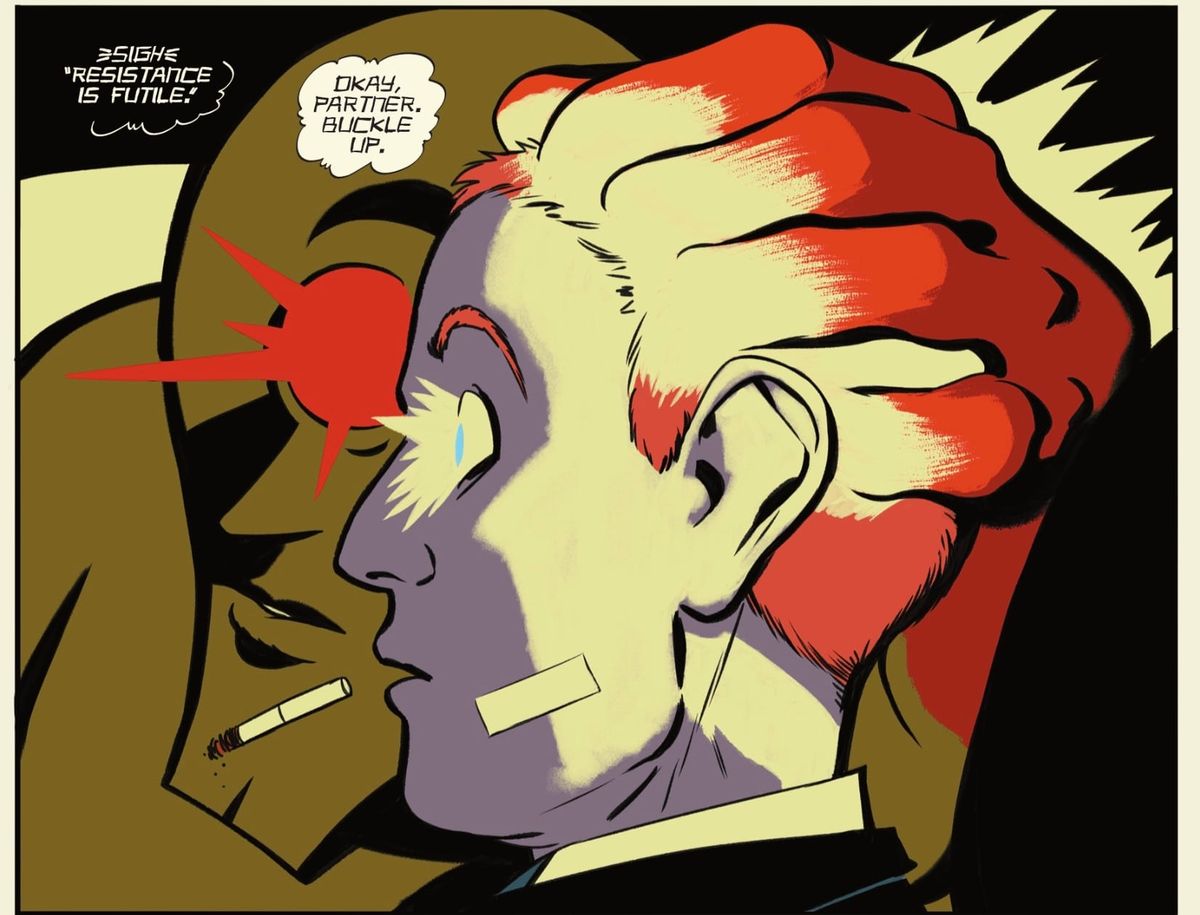
I think that we all recognize that the world isn’t what it’s supposed to be. Turn on any news channel and no matter your political or social leanings, we’re living in a world that is at war with itself, torn apart in new ways every day. Maybe this is just how it’s always been. At this point, I don’t know if I’ve ever experienced anything different enough to recognize another way of life. I just know that it’s worse now than it was then. (And “then”= yesterday/last week/ last month/last year, last decade/last century… take your pick.) Occasionally, we’ve felt close to gaining something good, something better, but now everything is just worse every day. Superheroes are supposed to give us hope. They give us a bit of belief that if tomorrow will be better than today for Spider-Man, then it could be better for all of us. Nice dream and one we need to hold on to.
Unfortunately, Absolute Martian Manhunter isn’t a superhero comic book.
Of all of the Absolute books, Absolute Martian Manhunter is the most grounded comic in the line. While the way this story is told is complicated and bordering on confusing, the world it takes place in may as well just be the world outside our windows. This branch of comics, taking a darker bent on the DC lore, is largely just a repackaging of other DC characters, updating their story for a 21st-century audience who know the lore thanks to comics, television shows, and movies. Another way to look at them is that they’re superhero comics for people who don’t want to read superhero stories— Trojan horse comics that do a good job of tricking a large audience into reading superhero comics (and isn’t that the result we’ve wanted after all of the movies and everything else?) And that doesn’t excuse Deniz Camp and Javier Rodríguez’s Absolute Martian Manhunter from being just another genre book but in this case, that genre isn’t superheroes.
Absolute Martian Manhunter is an alien invasion story.
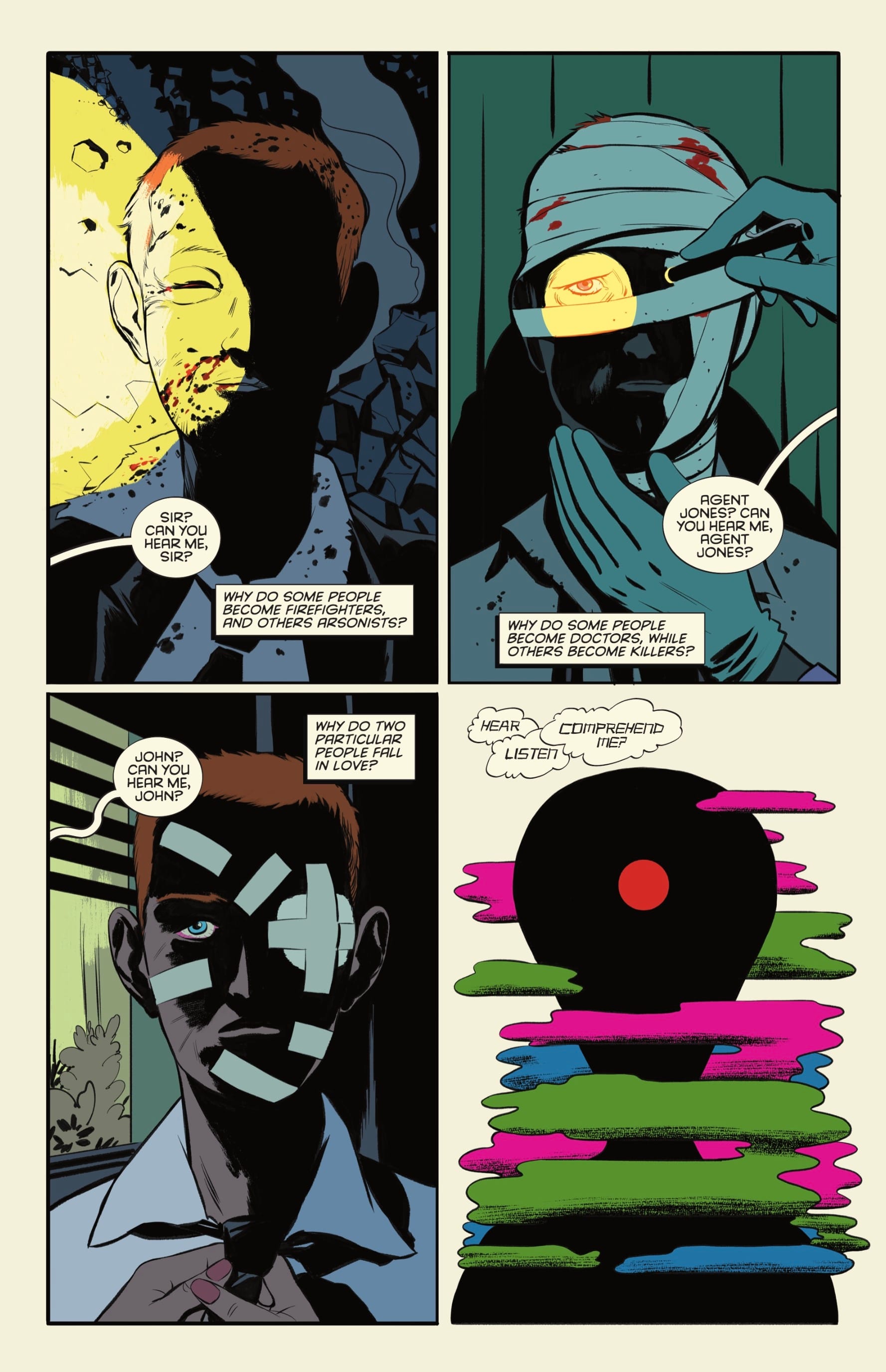
FBI agent John Jones has recently been reassigned to Middleton, a city where he, his wife, and his son don’t know anyone. They have no support structures other than themselves. After being caught in a domestic terrorist attack while standing in line at a coffee shop, Agent Jones starts to hear the voice of the Martian Mind-****er in the back of his mind (I’m sure you can fill in the missing letters to replace the “****”.) Trying to communicate with Jones in ways that he can understand, the Martian tells Jones he’s his new partner and they’re on a mission to save Middleton from a Martian invasion. And the Martians’ main weapon against humanity? Bad vibes. Just think about all of those negative thoughts in the back of your mind and imagine if they were weaponized against you. The Martians are amplifying those thoughts to turn us against each other.
Deniz Camp seems to be working through this cycle of stories about broken, fractured realities across three titles: Absolute Martian Manhunter, The Ultimates, and Assorted Crisis Events. Between these three titles that have been running concurrently, we see reality breaking down in ways familiar to comic readers and that reflect the times and lives that we’re caught up in right now. Marvel’s Ultimate line is actually fairly similar to DC’s Absolute line— a malevolent spirit (DC’s Darkseid or Marvel’s The Maker) infecting and remaking a universe in their image. They reimagine these comics and stories that we know like they were created in the 2020s and not the 1940s or the 1960s. Different times breed different strokes. Part of the fun of both lines is trying to trace all of these differences (Spider-Man is a man with a wife and kids before he ever gets his powers while Batman isn’t some rich kid orphan but still has all the toys (as well as some new ones)) but it’s fascinating how both lines needed a catalyst to ignite the storytelling, using that storytelling to show us just how far away we are from those 1940s and 1960s dreams.
Assorted Crisis Events uses the language of superhero storytelling— the Crisis event type of story perfected by Wolfman and Perez and trotted out by Marvel and DC on nearly a yearly basis since 1986– to do something very similar to the Absolute or Ultimate lines. But instead of having its roots in superhero stories, Camp and artist Eric Zawadzki are telling stories of normal people having crises in their lives against the backdrop of world-shattering crises. There are two levels to these crises, one large, grand, and overblown but that level gives Camp and Zawadzki an opening to tell these smaller, more personal stories. These stories allow us to suffer and to heal on a personal level even as there are all of these global crises and world events trying to beat us down.
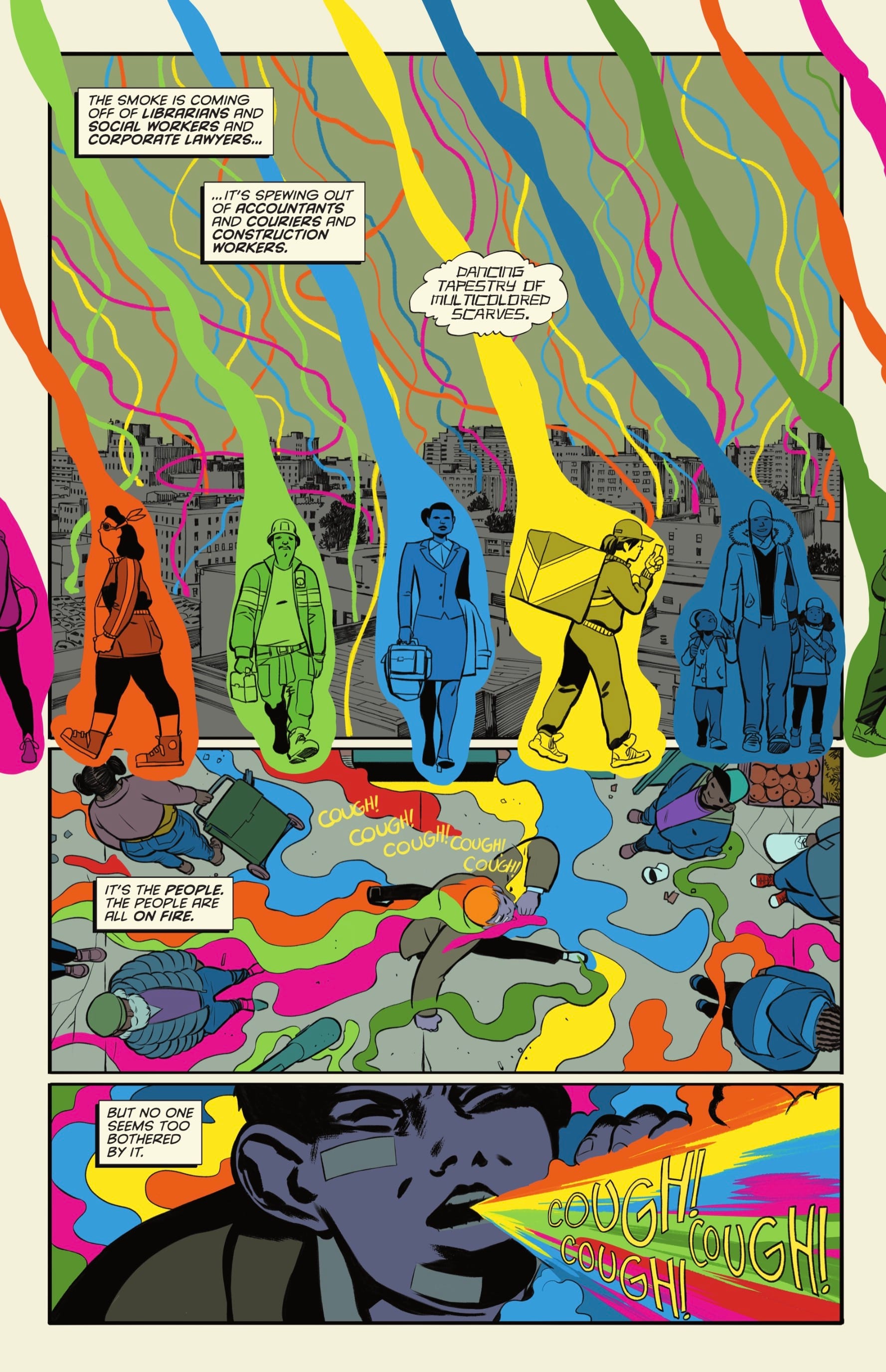
With Absolute Martian Manhunter, Camp’s John Jones is a suffering person with a relatable dilemma— is he a working FBI agent or a family man? Can he balance both parts of his life? The alien voices in his head don’t help either role, whispering to him about Martians working behind the scenes of reality to tear down humanity. While largely unseen, the Martians aren’t trying to take over or annihilate humanity but to strip away the various things, the thoughts and feelings, that make us human— attacks and shootings and arguments designed to chip away at things like the sympathy and empathy we have for our fellow humans. Partnered with his alien crime-busting partner, Jones tackles these anti-life forces.
Even as the Martian Mind-****er is trying to help Jones save the world, there’s the toll all of that takes on Jones’ family life. How can he be present for his wife and son when the world needs saving and Agent John Jones is the only one who can save it? This sets up the tension throughout the whole story where Jones could save the world or his family but can he save both? His wife Bridget represents everything that he’s trying to save and how he’s blind to the ways that he can actually succeed.
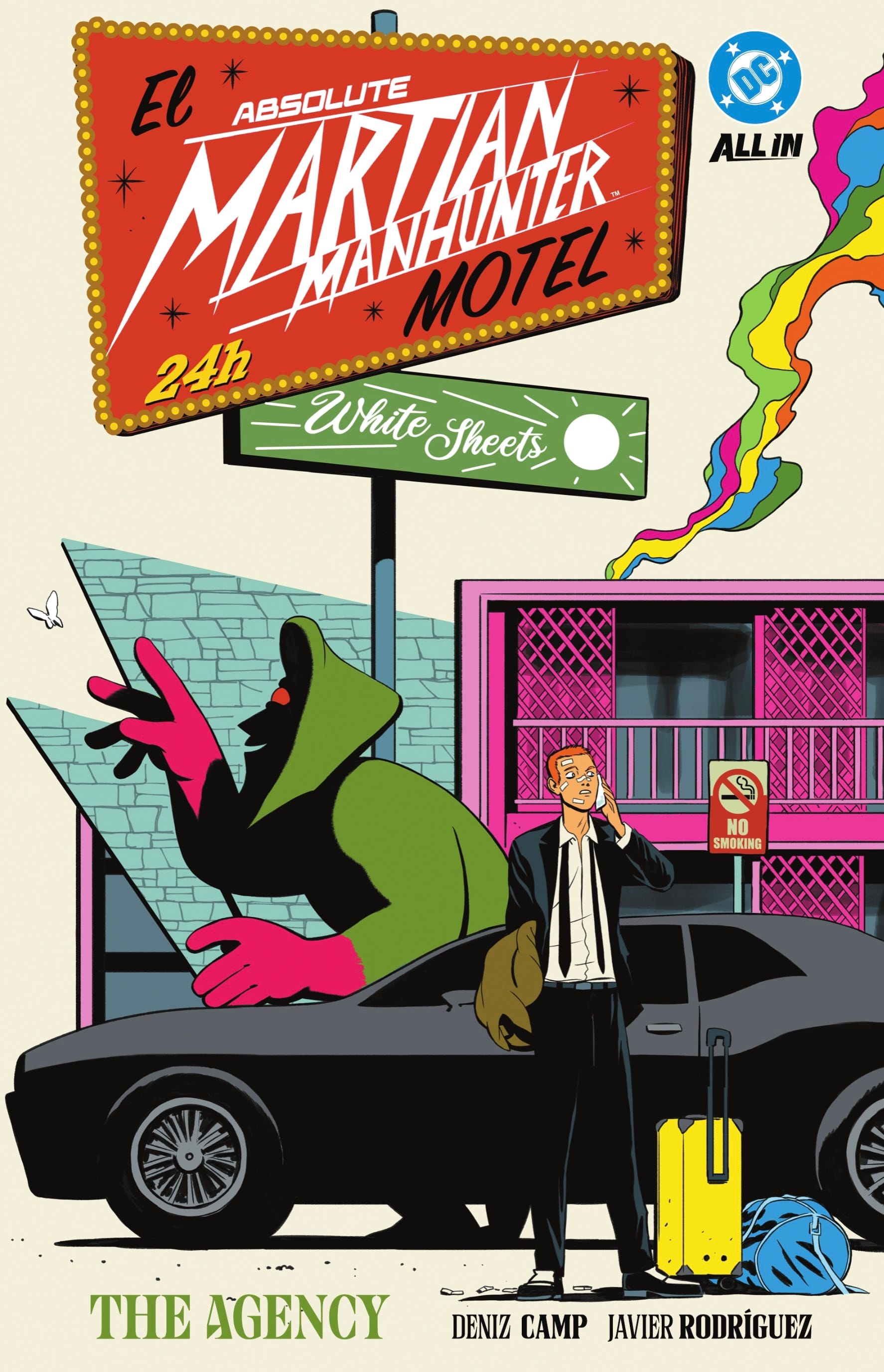
Javier Rodríguez’s Middleton serves as the battleground between humanity and the Martians. He brings alive this war that may be just happening in Jones’ head. His Martian Mind-****er is an abstract character— it’s just as easy to believe that these Martians are only a figment of Jones’ imagination as it would be to believe that they are real. The art leaves a lot of room open to question the reality of the situation here. Rodríguez’s drawings and colors show us how Jones’ is seeing the world around him— this artwork defines perception more than representation. The book calls it “ Martianvision” and it makes sense for what is ultimately a psychic war.
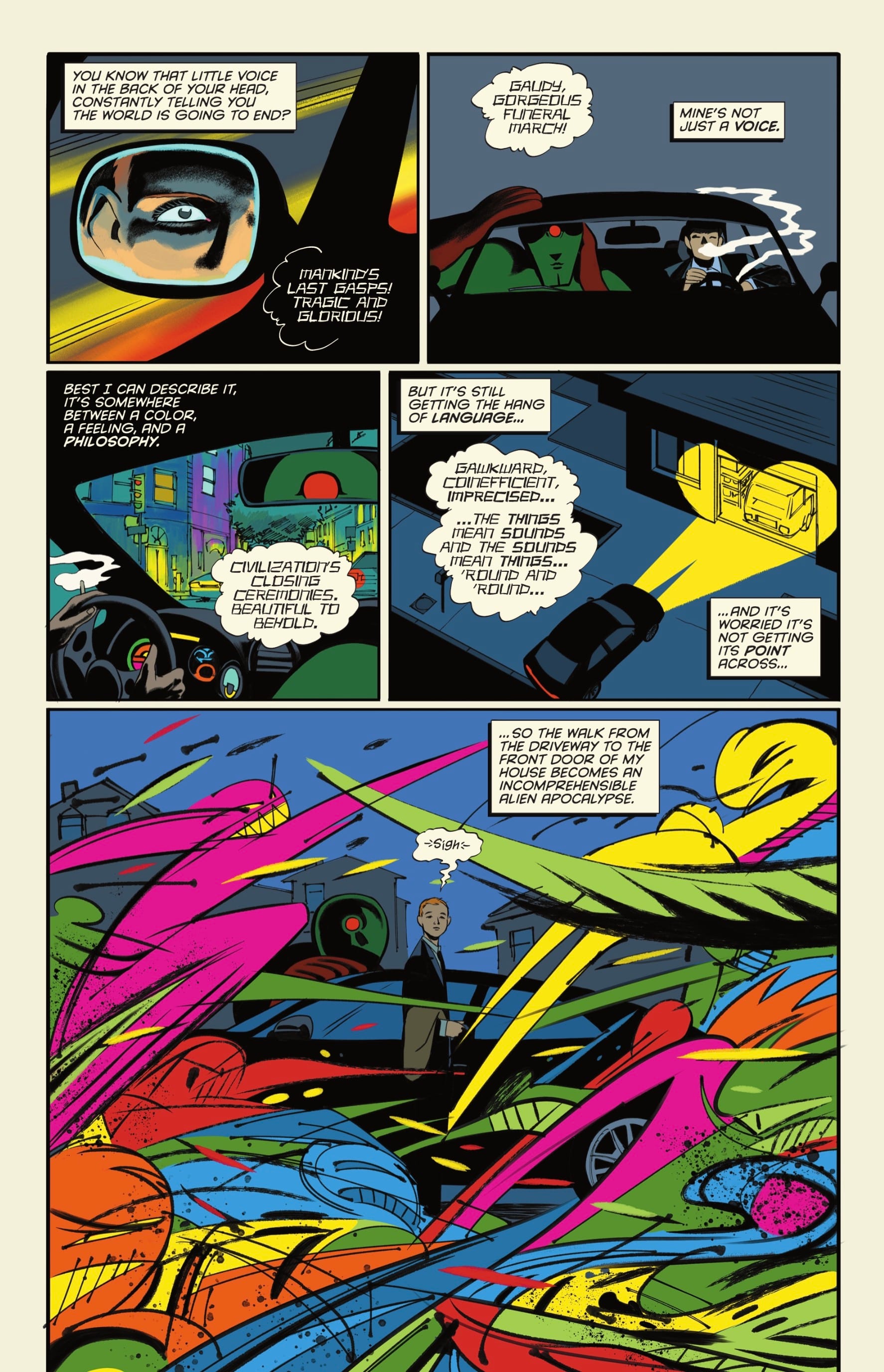
This “ Martianvision” infects nearly every panel of these comics— colored smoke that obfuscates the city landscape. Rodríguez makes what should be normal into an alien setting through the way that he works in the heightened reality and vision of the Martians and how Jones experiences it through his human perception. The infection of Martianvision makes Absolute Martian Manhunter an interactive read because you need to engage with the art to really understand the breakdown that Jones is going through.
This “ Martianvision” is just another heightened view of reality but allows Jones and us to see the Martians nittering away in the background and in the back of Jones’ mind. Camp and Rodríguez open up at least a couple of ways for us to read this. 1) The attack is real and the Martians are the army of dark forces. 2) As humanity breaks apart, Jones’ mind tries to apply some reason to help understand it so he creates the narrative of an alien attack happening in Middleton. It can probably be read one way if you’re trying to understand how this fits alongside books like Absolute Wonder Woman or Absolute Superman or another if you just want to engage with this one book, the story of FBI Agent John Jones.
In the end, it almost doesn’t matter whether the alien invasion in Absolute Martian Manhunter is real or not. As Deniz Camp explores the world around us, he uses this language of superhero and genre comics to give shape to the forces working against humanity. It feels like we should be able to identify it by one man or one economic class or one political view but Camp’s comics dig deeper into the rot. The systems at play in keeping us down are only a symptom of this breakdown that we’re living through right now. Absolute Martian Manhunter avoids the overt political statement and basically shows this as a fight between neighbors, against the men and women who live every day together on the streets and in the coffee shops of their town.
Thank you for reading From Cover to Cover.
Click here to receive new posts in your email and support our work through a tip at Ko-Fi.