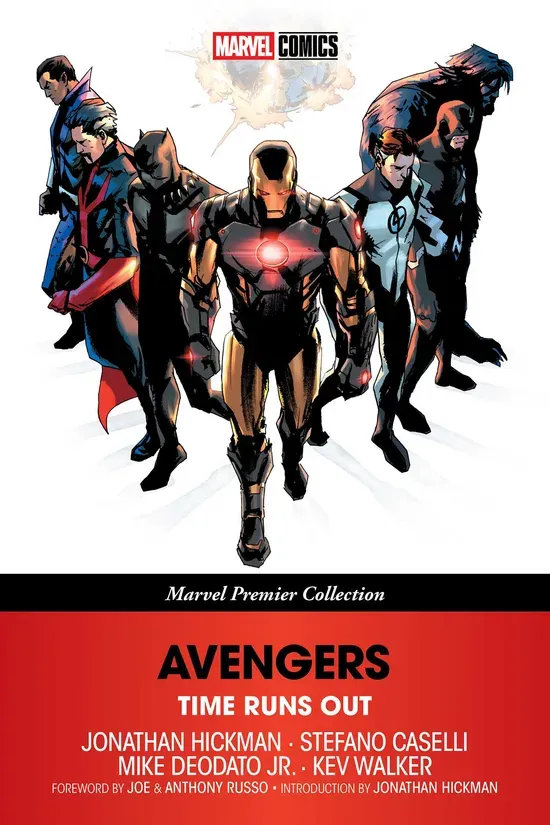
The Crisis Before The War in Avengers: Time Runs Out by Jonathan Hickman
This is the end of Jonathan Hickman’s Avengers story but not the end of his Marvel story.

A few things to know at the start:
- The new Marvel Premier Collection of Time Runs Out is an abridged version of Hickman’s story. The full story is available in Avengers By Jonathan Hickman: The Complete Collection Vol. 5.
- This isn’t the first Hickman Avengers story. It’s actually Jonathan Hickman’s finale to his multi-year/multi-titled run. And there are ways that it can be read as the last Avengers story.
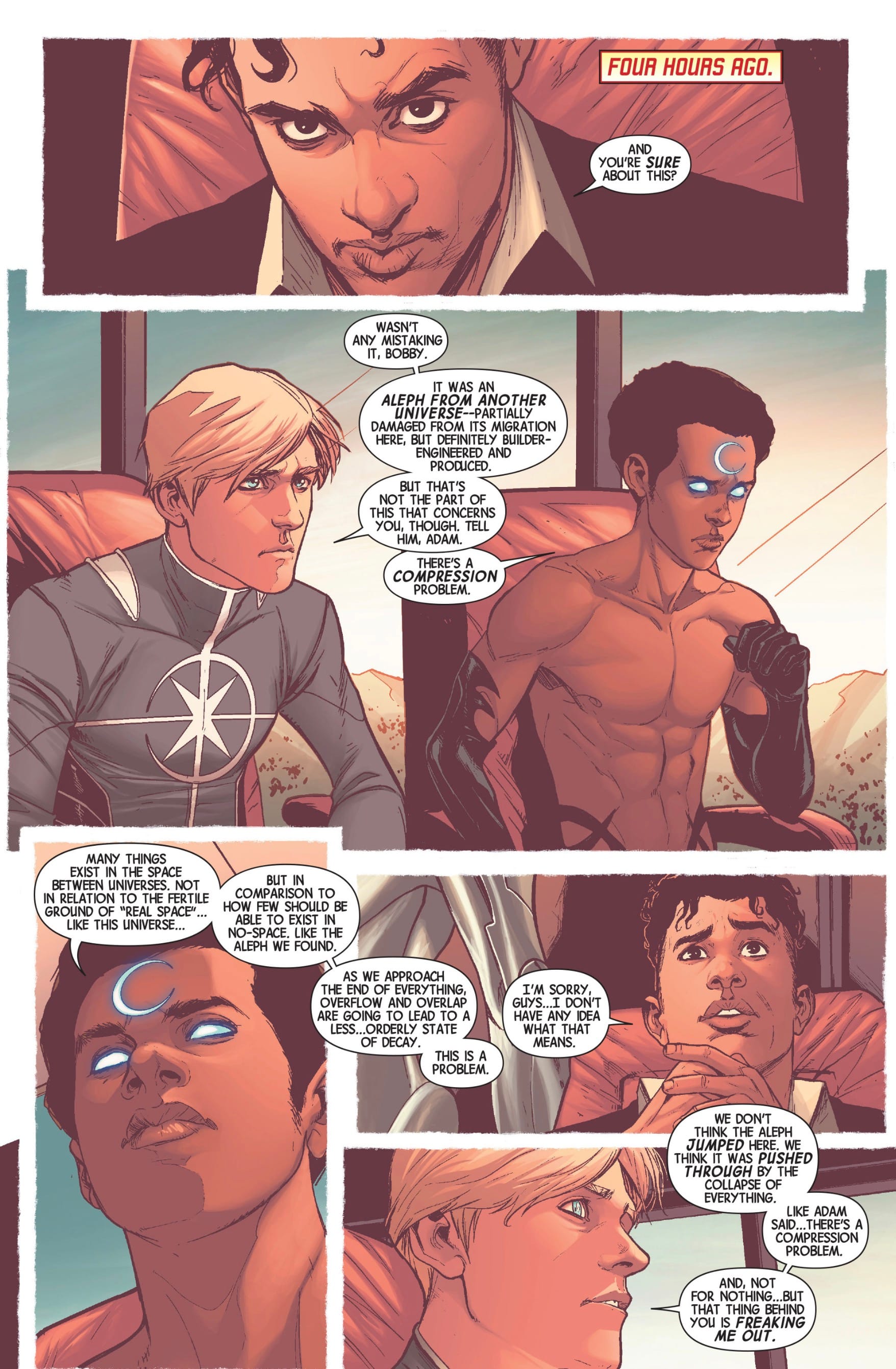
- The multiverse is collapsing in on itself. Universes are colliding, and the only way to prevent the destruction of both is to destroy the Earth in one of them.
- There are only a small handful of people on our Earth who knew about this and were acting to prevent the destruction of our universe. This includes Tony Stark, Reed Richards, T’Challa, Namor, Hank McCoy, and Stephen Strange.
- Steve Rogers has discovered that his former teammates have been killing other worlds and has organized SHIELD and his allies to hunt them down as criminals. This is where Avengers: Time Runs Out begins.
In other words, this is a book that requires a bit of homework to start it.
It’s clear from the start of Avengers: Time Runs Out that the heroes aren’t going to win. The rift between the team’s two leaders, Tony Stark and Steve Rogers, is just too deep for one of them to pull up to the other’s house, offer a heartfelt apology, and issue the call “Avengers Assemble!” to rally the troops back together. While on the surface of his Avengers run, Jonathan Hickman built a machine designed specifically to save everything, his story turned on two men’s pride and their need to always be right. They have already lost as Time Runs Out opens with the Avengers split into nearly unrecognizable fractions. Time Runs Out revolves around the failures of the two men who dreamed the dreams that everyone believed in.
Everyone remembers Hickman’s Secret Wars, but we rarely talk about the mad story that preceded it. For years before Secret Wars, Hickman told stories of Marvel’s superheroes basically fucking everything up. Reed Richards fucked up by trusting alternate-universe versions of himself in Hickman’s Fantastic Four run where the alternate versions had abandoned their family in their attempts to solve everything. Richards continued this pattern of trusting the wrong people in The New Avengers, egged on by Tony Stark and his merry band of universe killers to embrace his darker solutions. In The Avengers, Stark screwed everything up by secretly manipulating Steve Rogers and a whole team of super-powered beings for his own savior-complex agenda. And Steve Rogers fucked things up by not being able to see the world in anything other than black-and-white morality and looking for revenge instead of justice. Time Runs Out culminates all of that, finding the Avengers at their most petty. When Roberto DeCosta (Sunspot from The New Mutants and now leading his own faction of Avengers) is the voice of reason, you know you’re in trouble.
Is this Hickman showing that the idea of “superheroes” is over? “Everything dies” (the opening lines of his New Avengers run) is the most compelling statement of Hickman’s Avengers. It is fascinating to think that is what he was saying while Marvel’s corporate overlords Disney exploited the Avengers as the biggest franchise in the world. The Avengers were on lunch boxes, t-shirts, and in the toy aisles at Target and Walmart. That was the cultural impact of the Avengers when this was coming out, and here was Hickman over in the comics, the source material for all of this, going “look at this bunch of losers.”
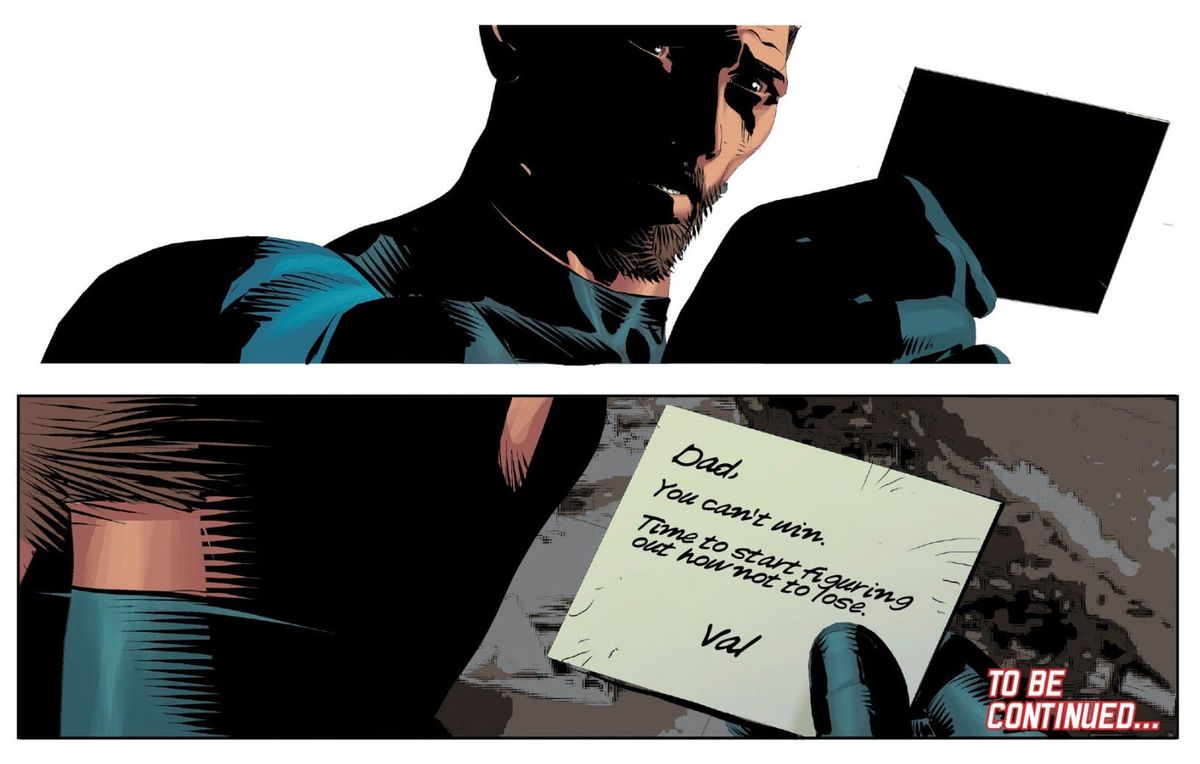
“You can’t win.
“Time to start figuring out how not to lose.”
That was a note that Valeria Richards wrote to her father early in Time Runs Out, but you have to wonder if Jonathan Hickman was writing it to himself as he raced toward the end of his Marvel multi-title epic story. Hickman set this story in motion with the heat death of the multiverse being imminent and now had to pay that off. It was time for the heroes to put up or shut up, but each faction of the Avengers here had a different idea of what “put up or shut up” meant. For Stark’s allies, it’s continuing the quest to save everything, a quest personified by Reed Richards. He sees the multiversal entropy as an unnatural act and will be damned if he lets a cosmic whim take his family from him. Rogers takes the moral high ground, hunting his former friends and teammates around the world like they are war criminals. They all betrayed his idealism and he’s not going to stop until his idealism rules the day again. Roberto DaCosta tries to be the adult in the room; he acts like a team leader for a team that unfortunately no longer exists.
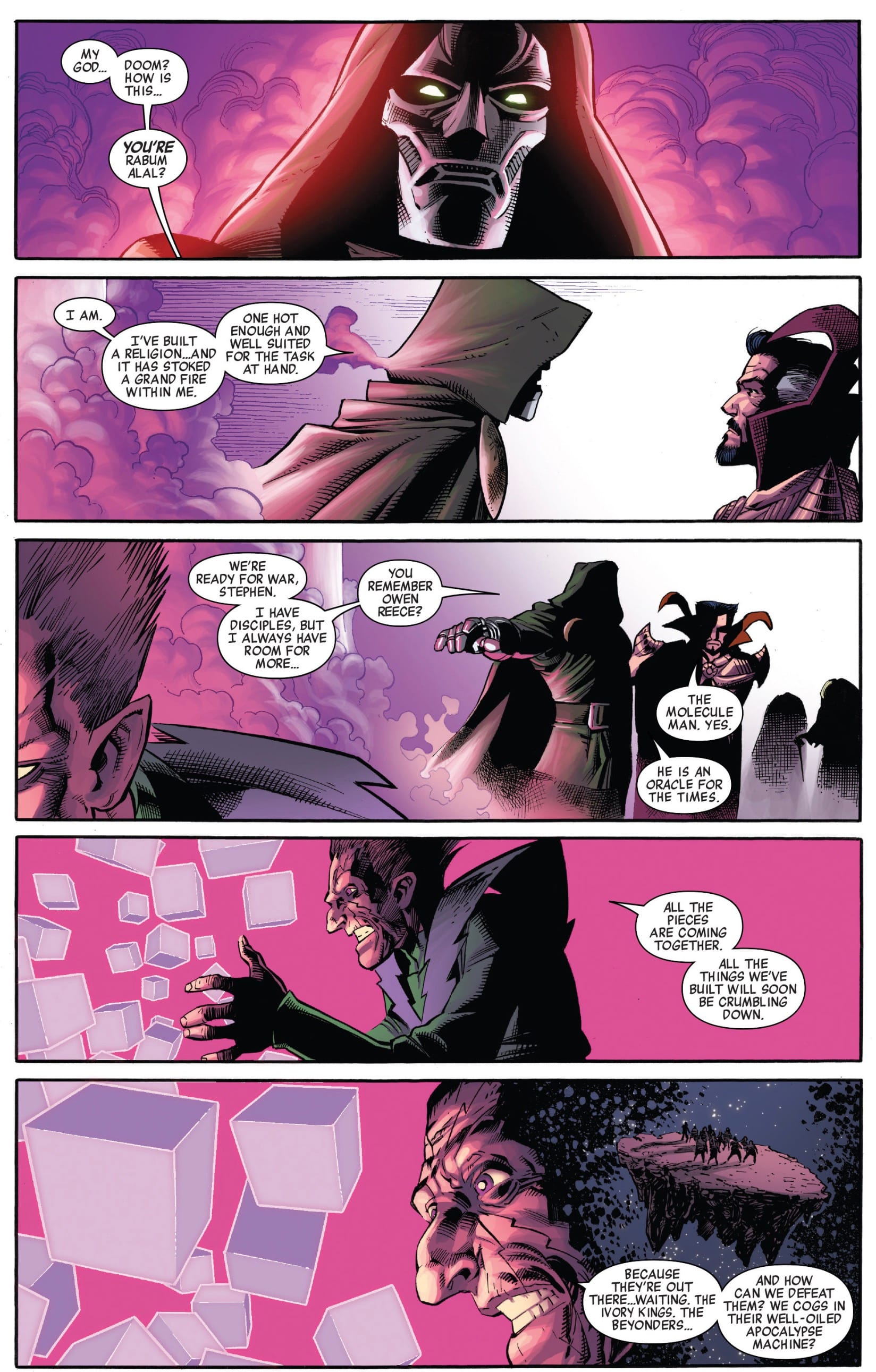
These are all mostly Earth-bound concerns, heroes fighting heroes to prove who is right and who is wrong. There’s another contingent, exploring the multiverse and trying to live up to Valeria’s request of figuring out how not to lose. Thor, Stephen Strange, Hyperion, and even Doctor Doom with the Molecule Man accept the call to act as warriors to discover the cause of the multiversal collapse and fix the universe. Stephen Strange ends up being one of the more interesting characters when he shows up here, living up to his profession as a doctor and methodically determining a course of action. Of all the characters here, Strange approaches this as a clinical problem, looking at everything more as a doctor than as a sorcerer supreme.
Thor is often part of Marvel’s Avengers trinity, fighting alongside Tony & Steve. The fact that Thor is in space, fighting the good fight but separate from his brother-in-arms, is another example of just how broken this team is. Due to events external to Hickman’s story (found in Jason Aaron’s excellent Thor run), Thor is unworthy at this point in this life, meaning that he’s lost his hammer so he’s lost everything. Losing his team may be a step too far for him so he joins Hyperion on what is essentially a suicide mission.
This version of Hyperion is a Hickman character, his riff on the Roy Thomas Superman-stand-in. Devised specifically for this Avengers run, along with a Starbrand and a Nightshade that Hickman borrows from Marvel’s 1980s experiment, New Universe. The inclusion of these characters expands Hickman’s story for those in the know about where they come from. Time Runs Out is a multiversal story before the movies made the multiverse all the rage so why not bring these elements into his story about the death of all of these universes?
This is the end of Hickman’s Avengers story but not the end of his Marvel story; this leads directly into Secret Wars, the story where Doctor Doom is God-Emperor Doom. In Time Runs Out, Doom is more active in the fate of the universe than nearly any other character. Valeria, Doom’s godchild, delivers the same message to Doom as she did to her father— “try not to lose.” But that’s not Doom’s style. He’s a “win it all or nothing” kind of man. He’s going to go all the way to win or lose everything. Accompanied by his own personal Molecule Man, a powerful being essential to every universe, Doom is fighting the same battle as Reed Richards, but Hickman demonstrates that Doom understands what is at stake more than Richards, Stark, or anyone else does. Richards is fighting for his family; Doom is fighting for everything.
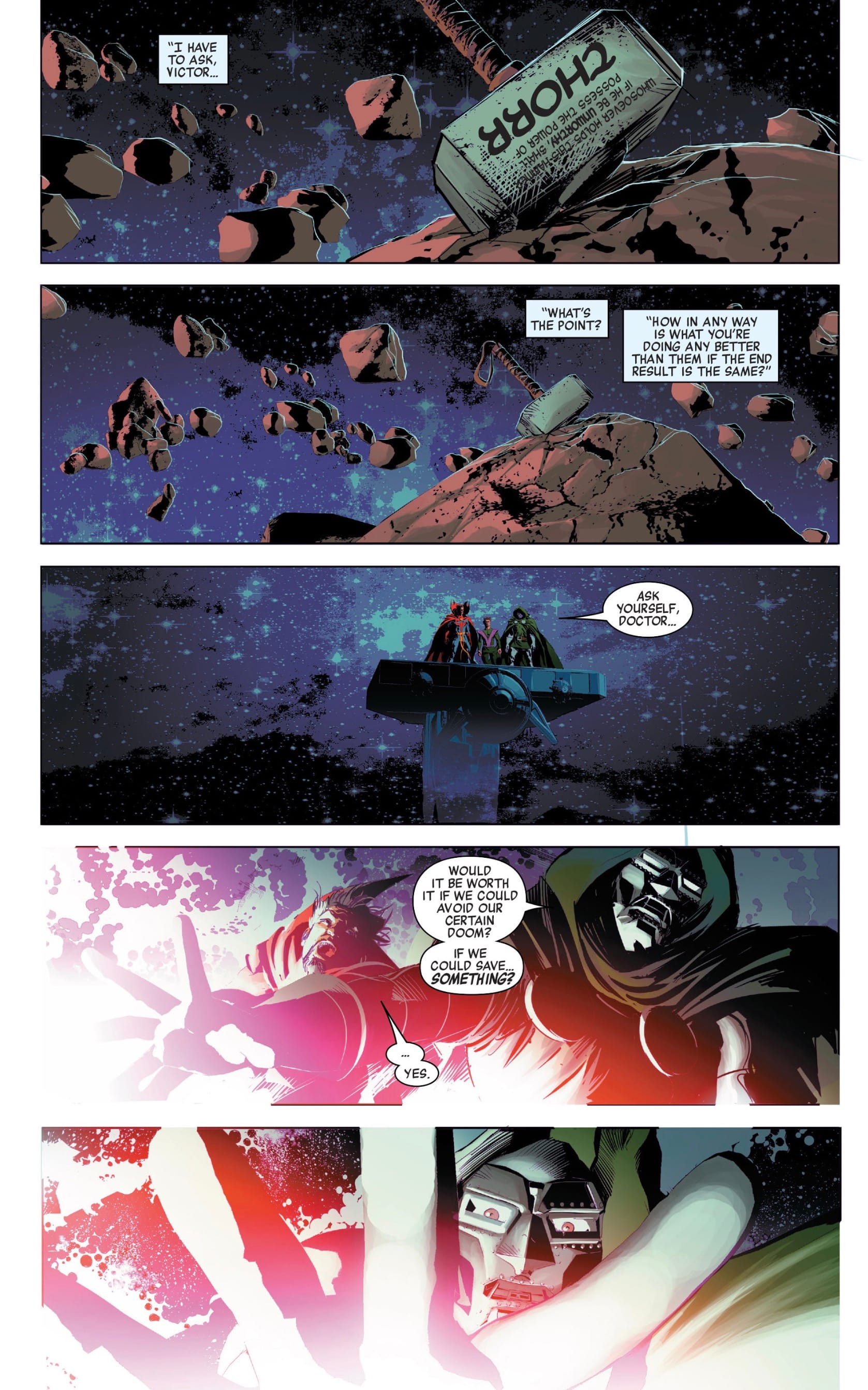
Hickman’s story needs realists in it, and here that is Doom. Doom sees the end of everything not in terms of raging-against-the-dying-of-the-light but as an opportunity to grab what he wants the most- power. He recognizes that the end of the multiverse will create a void, a Doom-sized void. Doom’s story is essentially a heist story. While everyone is distracted by incursions and petty squabbles, he sees the opportunity to get the power he’s long desired. If he pulls this off, he gets to be both savior and ruler over all of creation. He gets his ultimate victory over Richards if instead of stopping death, he steps into the void and is present at the birth of the new creation.
Time Runs Out is a messy book. Just as a starter, there are way too many artists to name working on this story. The look and quality of the art jumps all over the place as if the universal breakdown also caused a breakdown of the story’s artistic continuity. (But let’s be honest here, the multiple artists are probably more to get the book out on time than any kind of aesthetic statement. This needed to be wrapped up in time for Secret Wars to hit as scheduled.). There are also too many characters but it’s not like this should be a clean book. The messiness of the story is a character of it, not an impediment to it (although a bit more artistic continuity would have been appreciated.) The apocalypse should not be clean or easy. The end of everything should be chaotic and that is what this story is right from the beginning. This is Hickman’s Grand Guignol where the Avengers are backed up against the wall while everything falls apart around them.
And while all of the universe rages and dies around them, this story still comes down to Tony Stark and Steve Rogers unable to set aside their grudges so they end up just pummeling one another until one or the other relents, which both know is never going to happen. They know what the stakes are but from a storytelling point of view, it would be easy to get lost in all of the fireworks and distractions and forget the human side of this story. The final fight of the story isn’t Doom against heavenly beings but between these two men, lost in their anger toward each other. As the universe dies around them, they’re unwilling or unable to set their grievances aside.
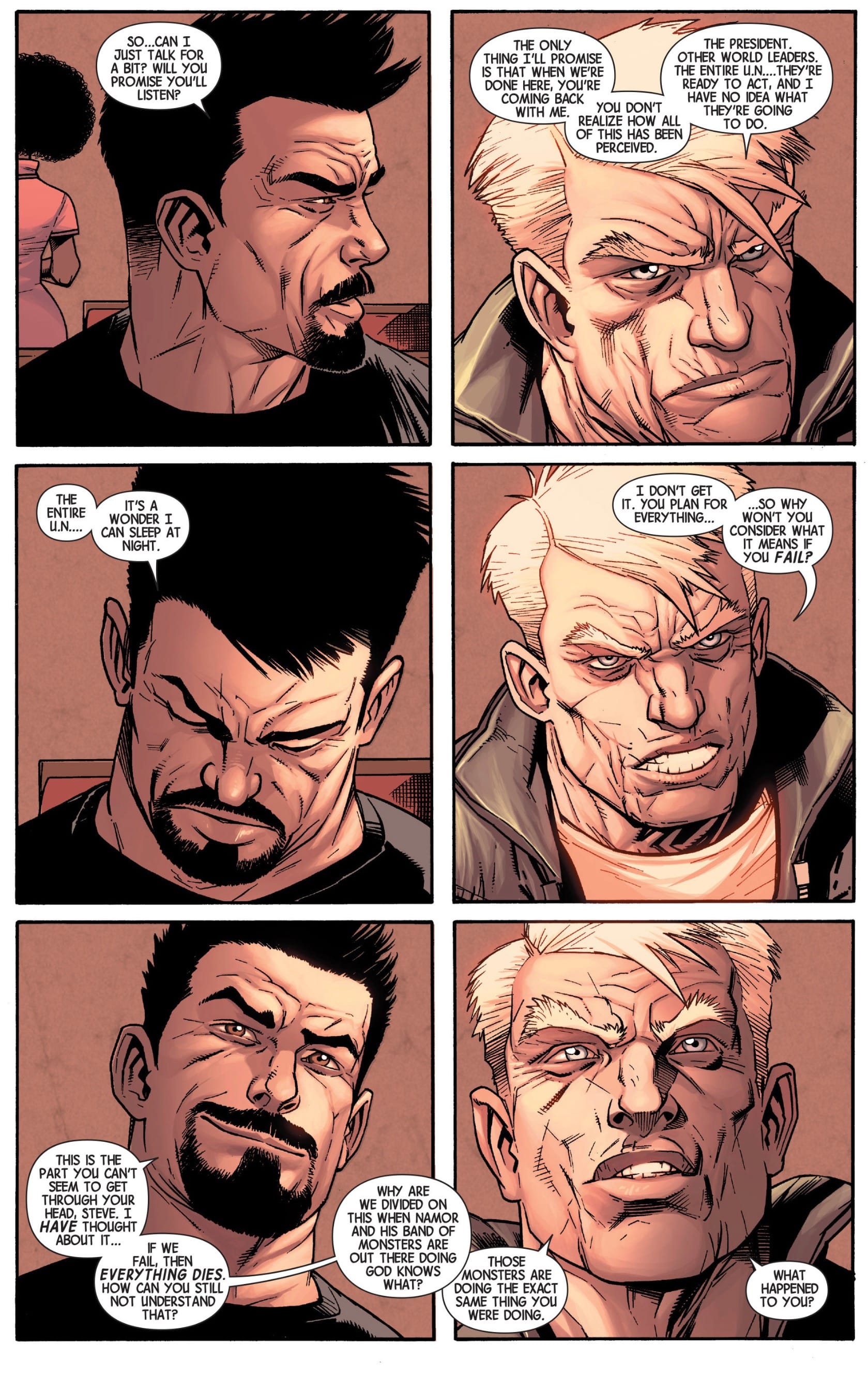
Tony and Steve’s story ends here. They play no part in Hickman and Esad Ribić’s Secret Wars (other than minor roles in some of the tie-in stories). There is no reconciliation or closure given to their fight other than it does on until everything comes crashing down around them. Most of the time at the end of these kinds of stories, the two would hug, make up, and then go out and save the universe with the rest of the Avengers.
At the end of Time Runs Out, everything dies— the one outcome that everyone was one way or another fighting against. Everything dies and the heroes are impotent against the decay eating away the multiverse. Hickman’s story is mean, ugly, and cynical as this version of the Avengers is built on deceit and betrayals. Everything dies, including the idealistic belief in superheroes.
Thank you for reading From Cover to Cover.
Click here to receive new posts in your email and support our work through a tip at Ko-Fi.