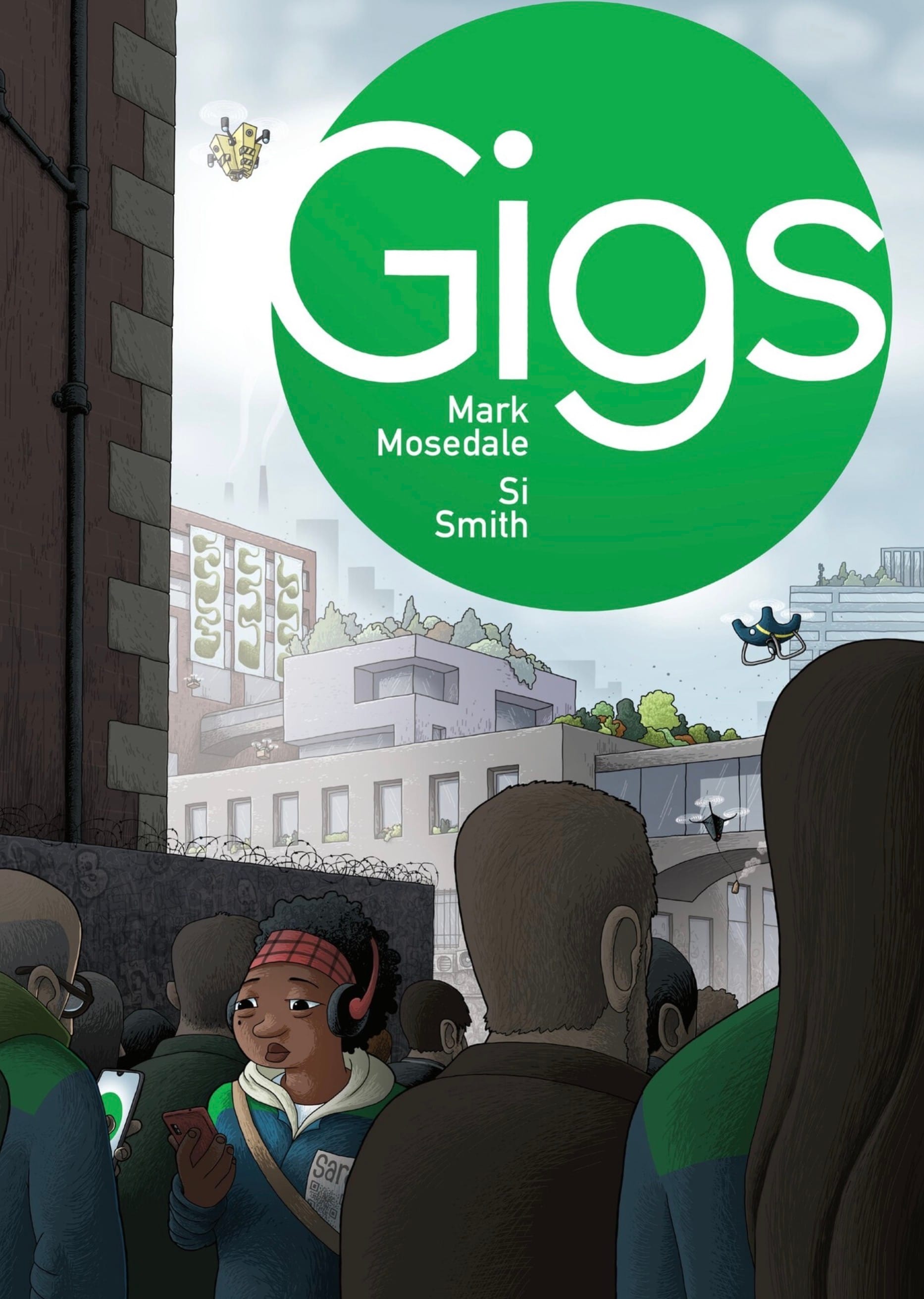
Gigs by Mark Mosedale and Si Smith
At the heart of Gigs is a brewing rebellion, encouraged by Syd and fought by Ivy and others against the systems built to oppress and control.

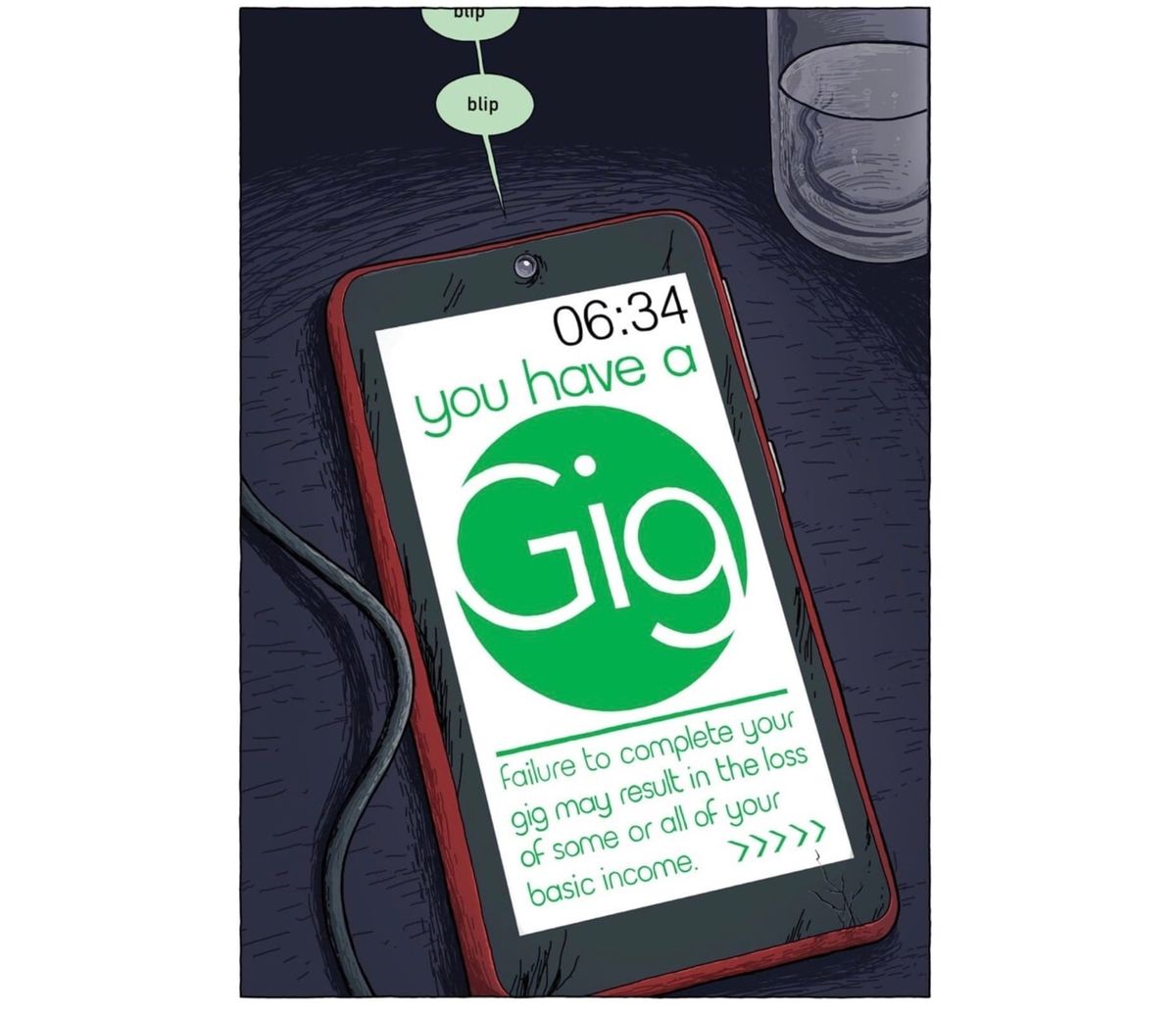
The future is now. In Gigs, Mark Mosedale and Si Smith tell a story that places us among gig workers, all waiting on the next notification telling us where to be and when to be there. Life is driven by work and technology. Ivy is caught up in that system, one of the masses picking up jobs that are assigned to her, or in this case, picking up jobs assigned to her sister, Sara, that Sara doesn’t want to do. Sara wants to stay at home and live in her virtual world. So she’s only too happy to pass her gifts off to her sister. At a temp job at a care facility, Ivy meets Syd, a one-time free thinker turned capitalist dreamer, whose code was eventually bought and gobbled up by the tech that powers the whole gig system. Gigs shows an existence that the technocrats have taken over, but the book shows that it’s not too late to reclaim our lives from uncaring systems.
Gigs takes place in a time and space where most people’s livelihoods are reduced to being where they’re told by their phones. When Ivy starts picking up her sister’s gigs at Oakview, an “arse-wiping gig” as her sister calls it, she finds Syd out back, smoking a joint. Syd claims it helps manage the “existential boredom that being in this horrible fucking place gives me.” The two eventually develop a friendship— Ivy finds someone to show her that there was life before the algorithms, and Syd finds someone who wants that life outside of the algorithms and gigs. At the heart of Gigs is a brewing rebellion, encouraged by Syd and fought by Ivy and others against the systems built to oppress and control.
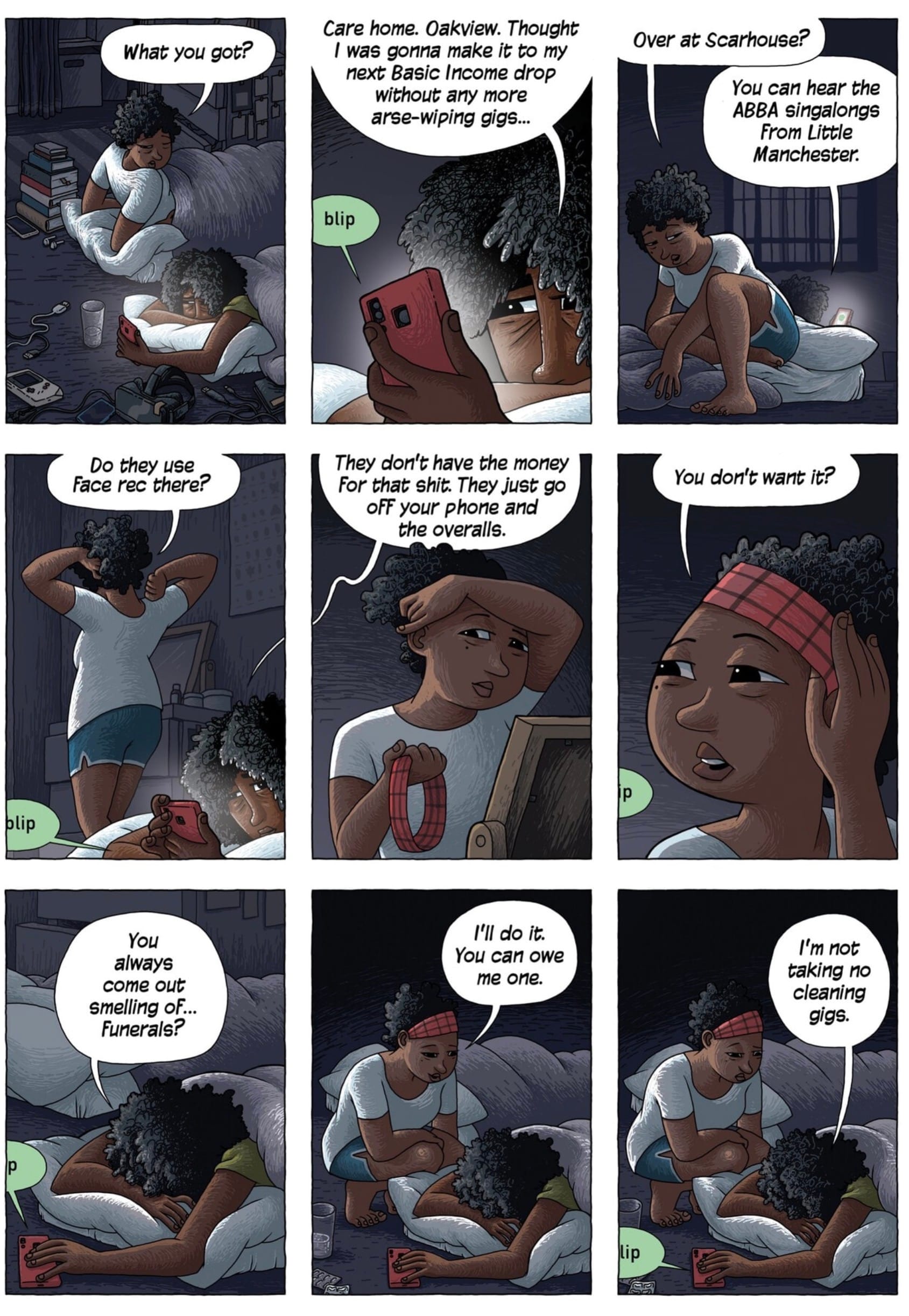
“I lost my independence to a fucking algorithm.”
That line when Syd laments the life she once had hits hard as I’m half working on this piece and half scrolling through YouTube, trying to find something to watch, a distraction from the real world. But the algorithm fails to find anything interesting enough to watch. Instead of just quitting the app and getting on with my life, I keep refreshing the screen, keep giving the algorithm another chance to get it right, scrolling through the feed, hoping for a good hit. Maybe I’ll switch over to Instagram, Threads, or Blue Sky. At least I have a choice of which “fucking algorithm” I’ll let run my life.
As much as Gigs is about those technologies, Mosedale and Smith don’t excuse us from letting go of the steering wheel of our lives. Or at least, they don’t excuse those of us from older generations, like Syd’s, who could have maybe set up guard posts once upon a time on technology where now it feels too late to reign any of it in. As Ivy looks around at this world where human life is valued too much by what you can contribute to the workforce and economy, it’s a world that she inherited but that Syd helped create. Mosedale and Smith don’t dwell on this accusation but get it out of the way and then move on. They define how we got here, but then spend more time figuring out how to move forward than pointing fingers at the past. It is important to understand where we’ve come from and who let it happen. These events are not just happening, but are the sins of the fathers and mothers that the children are now unable to escape. But the story is about the here and now, about the world that the children are inheriting, and not about the past.
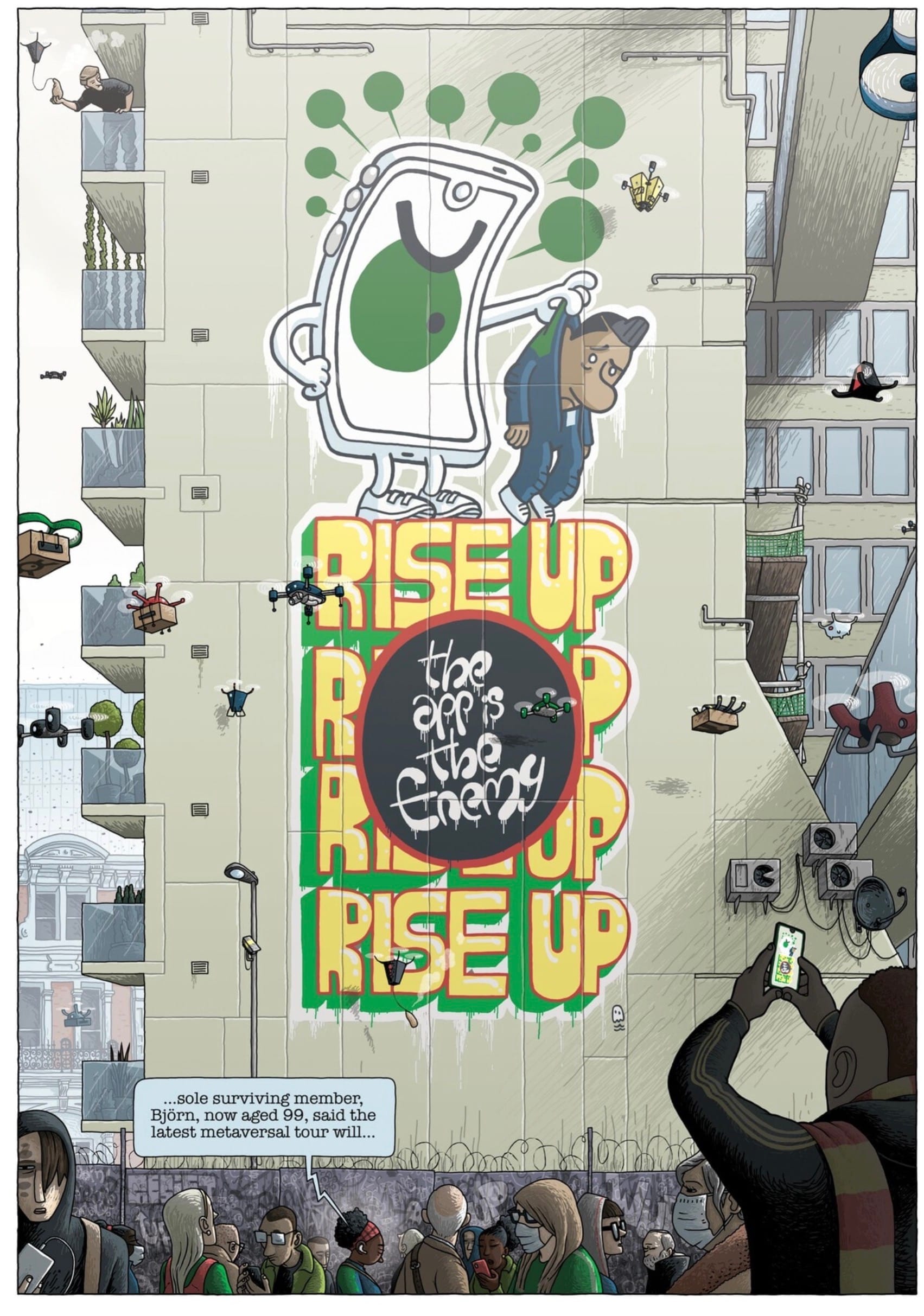
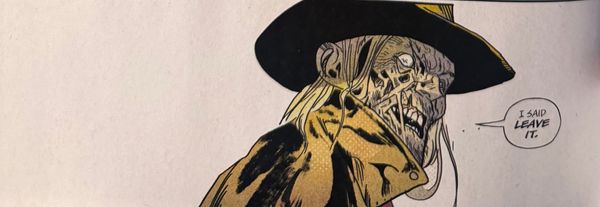
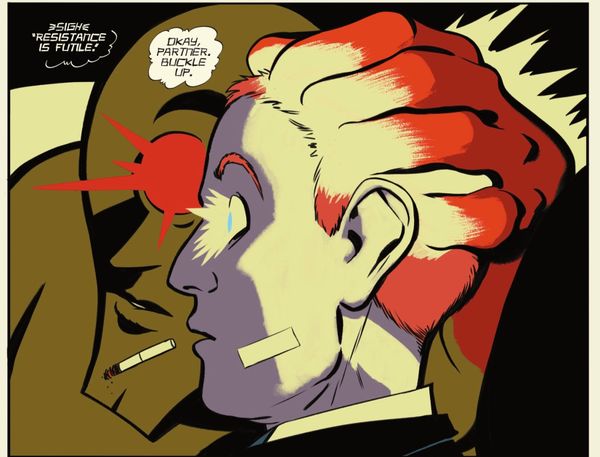
This world and its troubles are larger than just Ivy and Syd. At first, it almost seems like this is going to be an anthology book built around the concept of the gig economy, as Mosedale and Smith give us multiple stories and perspectives centered on this gig economy. After over a hundred pages focused on Ivy and Syd, Mosedale and Smith shift the focus to other characters controlled by this system, telling stories of others’ struggles and lives. Through each of these stories, they are showing that we can fight and push against these oppressive systems. In this world, we see everything from detectives to couriers to even astronauts existing and being controlled by this gig system. Any dignity of work has been reduced to an algorithm— the same thing that drives your TikTok viewing drives who gets assigned to a missing persons case. The same system that drives who cleans the toilets on an orbiting space station. In a world of DoorDash and Uber, it’s not a stretch to see where Mosedale and Smith take us in this book.
Smith’s drawings take us to many different places, both real and virtual spaces. He draws a story that’s the present as much as it is the future. The way Smith stages this story creates a tension that is a reflection of the plot. There are shades of Ridley Scott’s Blade Runner and Terry Gilliam’s Brazil in how this story balances the mundane, labor-focused story against the heightened drama of people trying to survive in this world. Smith captures the feeling of being trapped by our lives, a totally modern feeling, but projects it on a slightly futuristic setting. It’s a future that is only days or weeks ahead of us, not years or decades. The way he does it allows us to read this as speculative fiction about the future, while Mosedale's story feels very current and something that we need to address now.
Five or ten years ago, Gigs would have been pure science fiction, a dystopian view of a future controlled by the few who control the technology. It would have been more of a warning than a guidebook. In Ivy, Mark Mosedale and Si Smith show us a way to navigate the world, moving from just recognizing how the system works to reclaiming life from the devices in our pockets. The best science fiction reflects our times, and Gigs is a mirror for us as a society on the brink of monumental changes. It’s just a question of which way we change— for the better or for the worse?