
The Shared Headspace of Love and Rockets #17
More than a lot of issues of Love and Rockets, there’s a shared wavelength that Gilbert and Jaime are both operating on for these about this liminal space and time in these characters’ lives.

Let’s talk about Gilbert’s half of Love and Rockets #17 first. It feels like we’re moving through time and space with Fritz here. We’re light-years away from Palomar, but these stories of women and men feel like an abstracted version of those stories. Fritz confronts her past, her mistakes, and her ghosts. You could question if the events of this issue are literal— is Fritz walking naked through a forest, meeting these people, and having these discussions? But it doesn’t really matter whether or not this is something happening or a reflection of past events and emotions. Gilbert can get us into a kind of shared headspace with his characters. That’s the power of this storytelling, to create a space that’s shared between the story and the readers.
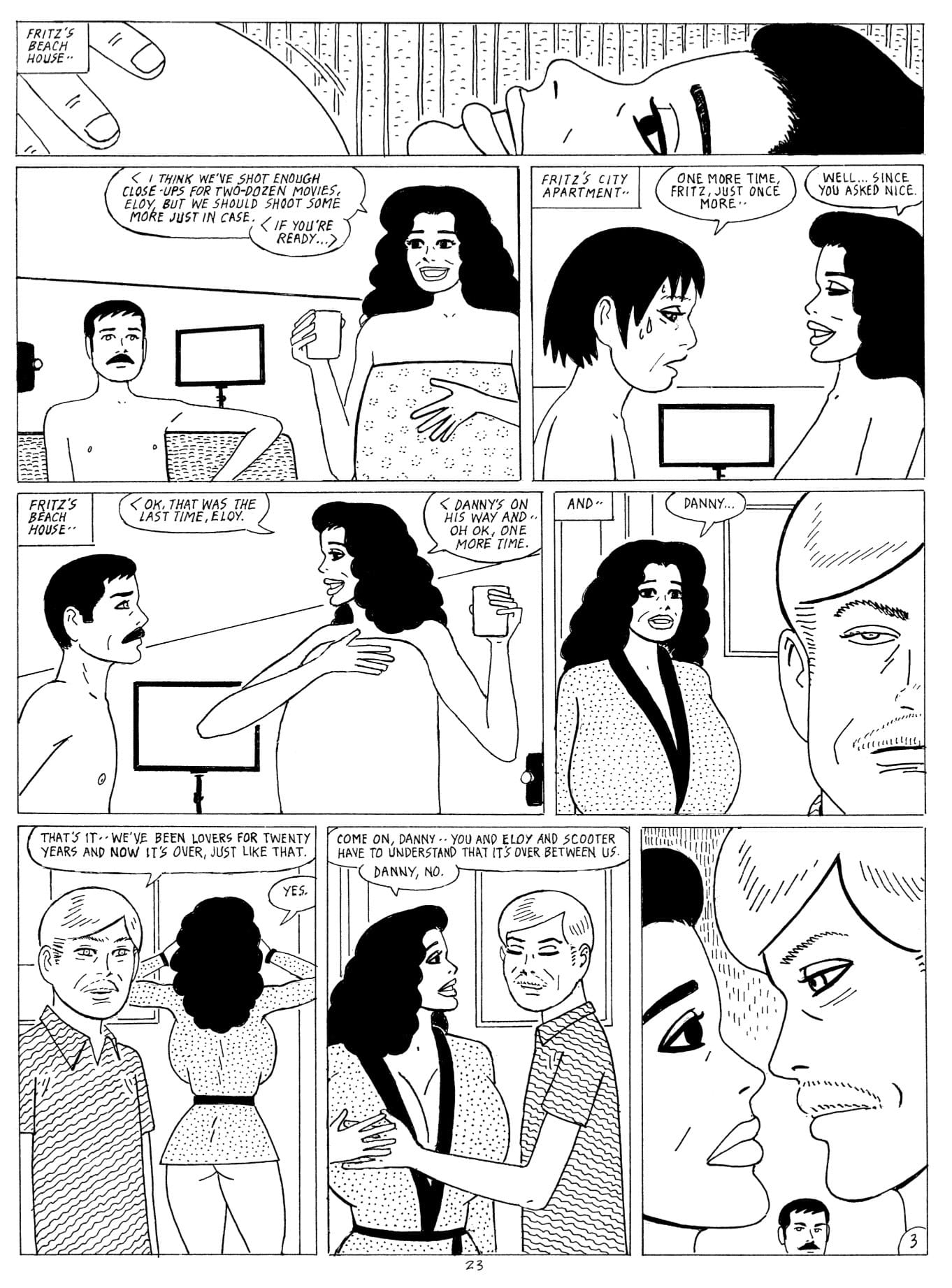
So here’s Fritz, walking through her life and trying to move forward behind the emptiness of it. For several years, his Fritz stories have felt cold & distant. Let’s be honest, while something is intriguing about these characters, Fritz and her family aren’t beloved characters in the L&R pantheon even if they’ve been the focus of Gilbert’s half of comics for years now. But something different is happening here in “Afterglow 2.0.”
Like for instance, Gilbert has never shied away from nudity, female or male. The bigger the breasts, the better for him (that’s an extreme generalization of his storytelling but it’s long been an element of it.). But here, he’s oddly self-censoring; he draws an empty rectangle covering every bare breast in the first half of his story. There’s plenty of other explicit and suggestive imagery here but its odd that there isn’t one fully naked breast or a penis in a story featuring Gilbert drawing a lot of naked women and men. Let’s be honest, that’s just what he does.
Nudity has always been a part of his storytelling; his characters are sexual and he hasn’t pulled back from that here. Fritz, her daughters, and the men in their lives are still sexual creatures in this comic but for Fritz, these encounters with her lovers are for the last time. At least, that’s what she tells them and herself. But it would be awfully strange at this point in his career if Gilbert were developing some prudish tendencies. And even by the way he draws the rectangles over the breasts, he’s drawing more attention to them. You notice his covering of breasts in the first half so when you get to the second half of his story, he’s more subtle in how he doesn’t show anything. It all draws attention to Fritz’s and tells us something is different here. Fritz is different.
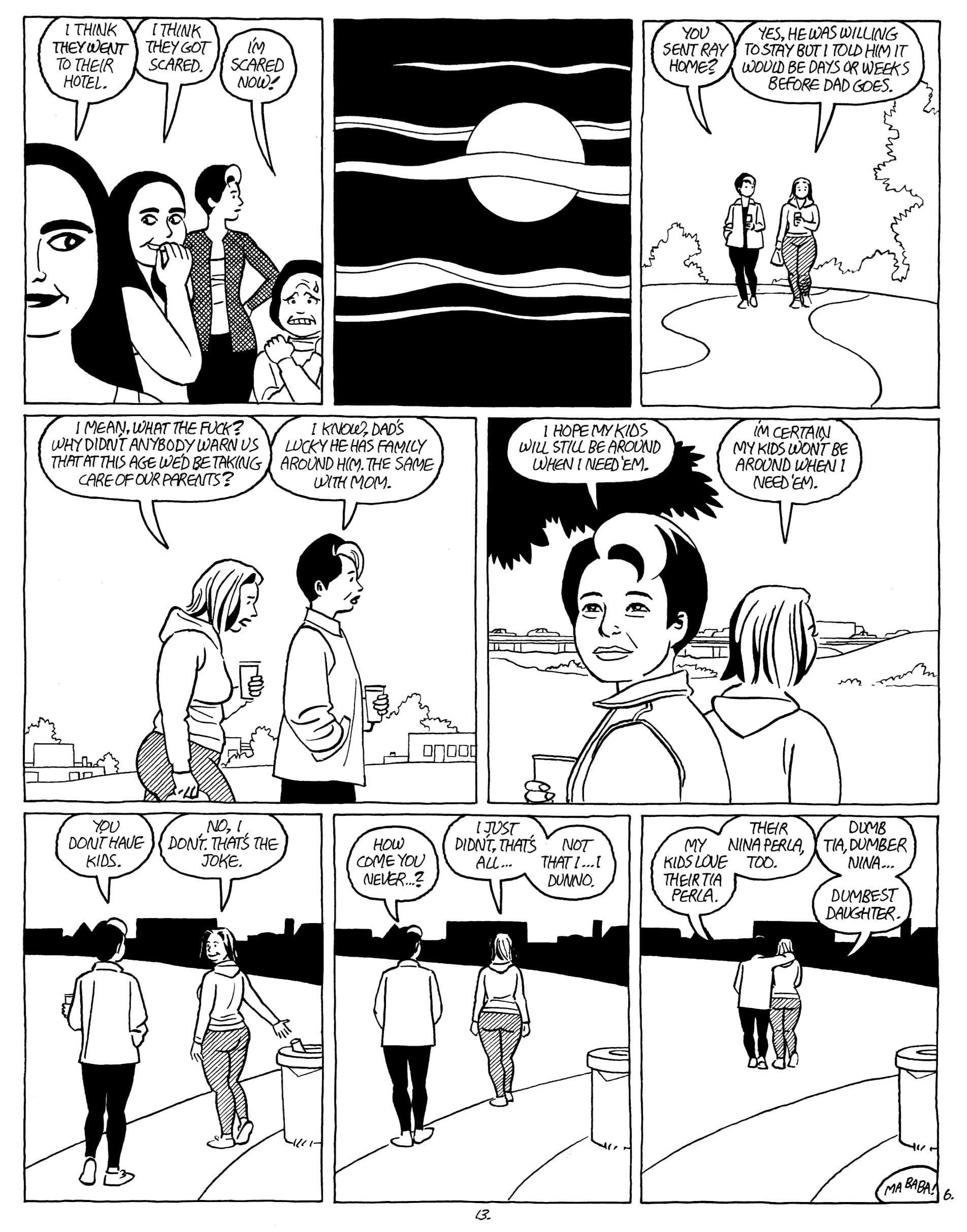
So that’s where it becomes interesting to compare what Gilbert is don’t here to Jaime’s work where Maggie and Ray have these family encounters with his brother and her father’s family. Jaime is 40+ years into Maggie’s story. He’s that much older than when he started and so are Maggie and Ray. Similar to Fritz, there’s an exploration of memories and ghosts that’s happening here. Ray (and Maggie’s) one-time lover Vivian (a.k.a. Frogmouth) is now their sister-in-law. She’s married to Ray’s brother Ignacio. Sitting out on a patio enjoying some time together, Ray and Ignacio share memories of their childhood like only brothers can— recalling early teenage nights spent looking for trouble and not really finding it. The flip side of this story is Maggie visiting her dying father, seeing the family he got after he left Maggie’s family, and awkwardly connecting with her sister over the whole situation. It’s not a place that Maggie or her sister wants to be but this is where their father is and it’s where they need to be. Both stories express love but also distance.
It’s both odd and comforting to think of Ray and Maggie as actual adults, facing these trials of aging. These were punks, artists, lovers, and fighters. But that was back when they were young. In this issue, Maggie tugs at her silver hair and comments that this is the first time she hasn’t colored it since her punk days. Again, a sign of moving beyond something. It’s funny how “Maggie & Ray” has replaced “Maggie and Hopey” but that’s 40 years of storytelling for you. “Maggie and Hopey” was practically its own brand; that relationship was punk circa the 1980s. Thanks to hindsight, maybe we can say now that of course, it was eventually going to run its course. But wasn’t Hopey the friend and lover that we all wanted— maybe not her specifically but that kind of intimacy with another person. Not to say that Ray is any better or worse but he’s safer than Hopey ever was; he’s stable in a way that Hopey isn’t and he’s what Maggie needs.
More than a lot of issues of Love and Rockets, there’s a shared wavelength that Gilbert and Jaime are both operating on for these about this liminal space and time in these characters’ lives. Jaime’s stories have been here for a bit, at least since The Love Bunglers which felt like it could have been the conclusion of Maggie’s story, and that came out 12 years ago (see Is This How You See Me or Life Drawings.) But since then, his stories have tried to find a new setting with Tonta and her crew; could they be the new punks? Maggie remains central to these stories but you can see Jaime trying to figure out what’s next. Similarly in this issue, Gilbert is in the same position; his stories have always been generational and while Fritz has been his focus for some time now, this issue seems to be questioning where we go from here.
Gilbert and Jaime are telling stories about, in, and through time. These aren’t forever young and forever unchanging comic characters, trapped in some nebulous and static time frame. To read an issue of Love and Rockets is to catch these characters at some specific point in their lives. That’s why rereads of this series are so satisfying; you can make all of these connections to things these characters have done or lived through before. Love and Rockets #17 shows us that things change but life goes on and that’s probably the big lesson that both Hernandez brothers teach us over the decades with their stories; there’s always tomorrow and all we can do is take these lives one day (or issue) at a time.